
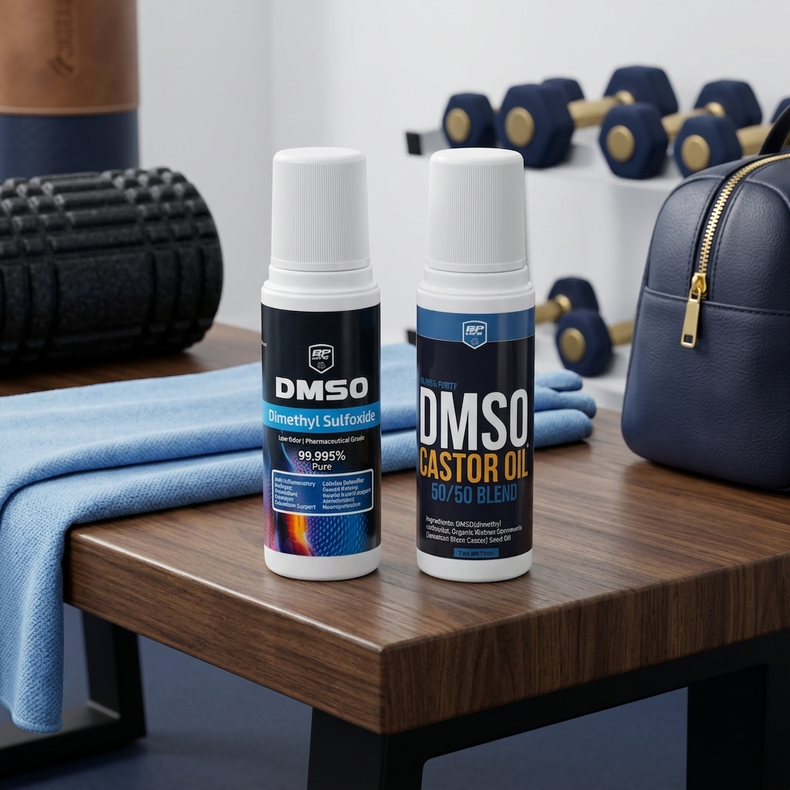
DMSO for Muscle Recovery: What Active People Should Know
By bb • BP Life • July 2026 • 7 min read
Whether you lift weights, run marathons, or just pushed it too hard on yard work — that deep muscle soreness the next day is something everyone knows. DMSO has been used by athletes, trainers, and active people for decades as a topical recovery tool. Here's what the research says and how people are using it.
Disclaimer: This article is for informational purposes only and is not medical advice. DMSO is FDA-approved only for interstitial cystitis. Uses discussed here are based on published research and user-reported experiences. Always consult your healthcare provider.
IN THIS ARTICLE
Why Muscles Hurt After Exercise
Post-exercise muscle soreness — commonly called DOMS (Delayed Onset Muscle Soreness) — typically peaks 24 to 72 hours after intense or unfamiliar activity. It's not just "feeling the burn." At the cellular level, several things are happening:
Micro-Damage
Intense exercise creates microscopic tears in muscle fibers. This is normal and how muscles grow stronger — but it triggers an inflammatory response.
Inflammation
Your body floods the area with immune cells and inflammatory markers. This causes swelling, stiffness, and that familiar deep ache.
Oxidative Stress
Exercise generates free radicals that can damage cells and slow recovery if not neutralized.
The goal of any recovery strategy is to manage inflammation, reduce oxidative stress, and support the body's natural repair process — without blocking the adaptation signals that make you stronger. This is where DMSO's unique properties become relevant.
How DMSO Supports Muscle Recovery
DMSO addresses post-exercise muscle soreness through multiple mechanisms that align directly with the recovery process:
| Recovery Need | What DMSO Does |
|---|---|
| Reduce inflammation | Lowers pro-inflammatory cytokines and reduces edema (swelling) in muscle tissue |
| Neutralize free radicals | Scavenges hydroxyl radicals — among the most destructive byproducts of intense exercise |
| Relieve pain | Selectively blocks C-fiber nerve conduction, providing relief without numbing the entire area |
| Relax muscles | Reduces skeletal muscle tension and spasms that can persist after heavy training |
| Improve circulation | Increases blood flow to the treated area, delivering nutrients and oxygen for repair |
| Deep penetration | Reaches muscle tissue within minutes — unlike topical creams that stay in the skin |
DMSO doesn't just sit on the surface like most topical products — it penetrates to the muscle tissue itself, delivering anti-inflammatory and antioxidant properties exactly where recovery happens.
What the Research Shows
DMSO's effects on muscle tissue have been documented across multiple research areas:
Anti-Inflammatory Action in Muscle Tissue
Studies have shown that DMSO reduces inflammatory markers at the cellular level — the same markers that drive post-exercise soreness. Unlike oral anti-inflammatories (NSAIDs), topical DMSO delivers this effect locally without circulating through the digestive system or bloodstream.
Free Radical Scavenging
DMSO is one of the most potent hydroxyl radical scavengers identified in research. During intense exercise, hydroxyl radicals are produced in large quantities and contribute to muscle cell damage and delayed recovery. DMSO's ability to neutralize these radicals may help protect muscle tissue during the recovery window.
Muscle Relaxation
Research has documented DMSO's ability to relax skeletal muscle. For athletes dealing with post-workout tightness, cramping, or spasms, this property can support faster return to normal range of motion.
Edema Reduction
Swelling in muscle tissue after exercise restricts movement and prolongs soreness. DMSO has been shown to help drain excess fluid from tissue, reducing the pressure and discomfort associated with post-exercise inflammation.
Veterinary Precedent
In equine sports medicine, DMSO has been used for decades to manage exercise-related muscle and joint issues in performance horses. The FDA approved DMSO for veterinary use based on this extensive track record. While animal research doesn't directly translate to humans, the consistent results across species support DMSO's role in musculoskeletal recovery.
The mechanisms are well-documented in published research. Large-scale human clinical trials specifically for exercise recovery are limited, largely because DMSO is off-patent and no company has financial incentive to fund them. The evidence base comes from mechanistic studies, observational data, veterinary medicine, and decades of user-reported experience.
How to Apply DMSO for Recovery
Shower or clean the area first
Remove sweat, dirt, and any topical products. DMSO carries whatever is on your skin through it — so clean skin is essential.
Apply DMSO to the sore muscle group
Use a glass dropper (liquid) or roll-on. Cover the entire muscle area — not just the sorest spot. Soreness often extends beyond the point of maximum discomfort.
For legs: Apply to quads, hamstrings, or calves broadly. For upper body: Cover the full shoulder, chest, or back area that was trained.
Let it absorb completely
Wait 15-20 minutes before putting on clothing or compression gear. The skin should feel dry to the touch.
Repeat as needed
Apply 1-2 times daily during heavy training periods, or as needed after particularly intense sessions.
The roll-on applicator is especially convenient for post-workout use — it applies evenly, doesn't drip, and you can keep it in your gym bag. No mess, no measuring.
For complete application instructions: How to Use DMSO Topically: A Beginner's Guide →
When to Apply: Pre-Workout vs. Post-Workout
Users incorporate DMSO into their routines at different points. Both approaches have merit:
Pre-Workout Application
- May help improve circulation to the target area before training
- Users report less stiffness during warm-up
- Apply 20-30 minutes before exercise
- Let it fully absorb before sweating
- Best for: chronic tightness, recurring problem areas
Post-Workout Application
- Targets the inflammatory response as it begins
- May reduce the severity of next-day DOMS
- Apply after showering post-workout
- Most popular timing among users
- Best for: heavy training days, new exercises, competition recovery
Always apply DMSO to clean, dry skin. After a workout, shower first to remove sweat, pre-workout supplements, and any topical products before applying DMSO.
DMSO vs. Other Recovery Methods
| Method | How It Works | Limitations |
|---|---|---|
| DMSO (topical) | Penetrates to muscle tissue; anti-inflammatory, antioxidant, analgesic, muscle relaxant | Garlic taste; requires clean skin |
| Ice bath / cold therapy | Constricts blood vessels, numbs area, reduces acute swelling | Uncomfortable; may blunt muscle adaptation signals |
| NSAIDs (ibuprofen) | Systemic COX inhibition reduces inflammation | GI risk; may impair muscle protein synthesis and adaptation |
| Topical menthol/camphor | Creates cooling sensation; mild distraction from pain | Stays on skin surface; no deep tissue penetration |
| Foam rolling | Mechanical pressure breaks up adhesions, improves blood flow | Manual effort; limited reach for some muscle groups |
| Compression gear | External pressure reduces swelling | Passive; doesn't address inflammation at cellular level |
Most recovery tools work on the surface. DMSO is one of the few topical compounds that actually reaches muscle tissue — addressing inflammation, oxidative stress, and pain at the source.
Many users combine DMSO with other recovery methods. For example: DMSO post-workout, foam rolling the next morning, and compression during the day.
Frequently Asked Questions
There is no published research suggesting DMSO interferes with muscle protein synthesis or adaptation. Unlike oral NSAIDs — which some studies suggest may blunt the muscle-building response — DMSO works locally and through different mechanisms.
Do not apply DMSO over other topical products. DMSO will carry whatever is on your skin into your body. Apply DMSO to clean skin only, and wait for full absorption before applying anything else.
DMSO itself is not on the World Anti-Doping Agency (WADA) prohibited list. However, because DMSO can enhance the absorption of other substances, athletes subject to drug testing should be mindful of what they apply alongside DMSO. Check your sport's specific rules.
As soon as practical after showering. The inflammatory response begins within hours of exercise, so earlier application may help manage it before it peaks. Most users apply within 1-2 hours post-workout.
Both work well. Roll-on is more convenient for quick application to large muscle groups (legs, back) without mess. Liquid gives you more control over coverage area and can be diluted if needed. Read the full comparison →
Yes. DMSO has no documented tolerance buildup or cumulative toxicity. Many active users apply it daily during training blocks. Always use pharmaceutical-grade purity. Read our safety guide →
Recovery is where gains are made. DMSO gives active people a topical tool that actually reaches the muscle — reducing inflammation, scavenging free radicals, and supporting the body's natural repair process.
Shop BP Life DMSO — 99.9% Pure, Pharma Grade, 3rd Party Tested
4oz Glass Dropper 3oz Roll-On 8oz Glass BottleThis article is for informational and educational purposes only. It is not intended to diagnose, treat, cure, or prevent any disease. Consult your healthcare provider before starting any new wellness routine.