
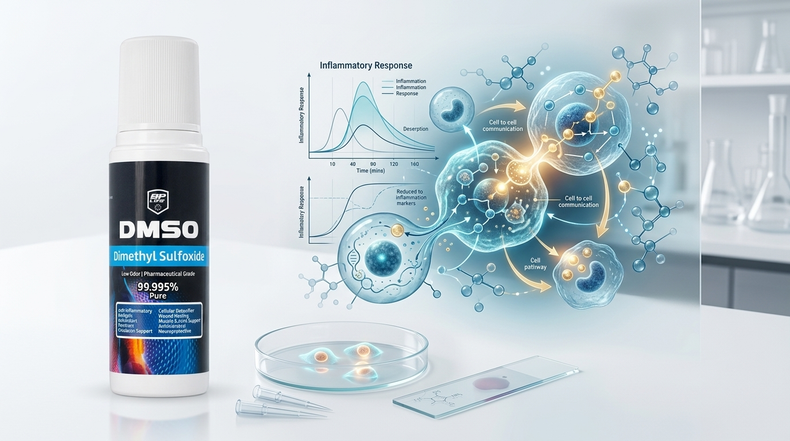
DMSO and Inflammation: A Research Overview
By bb • BP Life • July 2026 • 7 min read
Inflammation is the body's natural response to injury and stress — but when it becomes chronic, it can drive discomfort, stiffness, and long-term tissue damage. DMSO's anti-inflammatory properties are among the most studied aspects of this compound, and they're the primary reason it has attracted interest from researchers, clinicians, and users for over six decades.
Disclaimer: This article is for informational purposes only and is not medical advice. DMSO is FDA-approved only for interstitial cystitis. Anti-inflammatory properties discussed here are based on published research, not FDA-approved claims. Always consult your healthcare provider.
IN THIS ARTICLE
What Is Inflammation (and When Is It a Problem)?
Inflammation is your body's defense system. When you twist an ankle or catch an infection, inflammation rushes blood, immune cells, and healing factors to the area. This acute inflammation is healthy — it's how you heal.
The problem arises when inflammation becomes chronic — lingering for weeks, months, or years. Chronic inflammation has been linked to:
Joints & Muscles
- Persistent joint stiffness
- Muscle soreness that won't resolve
- Reduced range of motion
Tissue & Skin
- Slow wound healing
- Persistent swelling (edema)
- Tissue damage over time
Systemic Effects
- Fatigue and brain fog
- Increased oxidative stress
- Accelerated cellular aging
This is where DMSO enters the picture — not as a cure for inflammation, but as a compound that research shows can modulate multiple inflammatory pathways simultaneously.
DMSO's Anti-Inflammatory Mechanisms
DMSO doesn't just mask inflammation the way a painkiller numbs symptoms. Research indicates it works through several distinct mechanisms:
| Mechanism | What the Research Shows |
|---|---|
| Cytokine reduction | DMSO has been shown to lower levels of pro-inflammatory cytokines — the signaling molecules that amplify and sustain the inflammatory response. |
| Free radical scavenging | DMSO acts as a potent hydroxyl radical scavenger. Hydroxyl radicals are among the most destructive free radicals in the body, driving oxidative damage in inflamed tissue. |
| Edema drainage | DMSO helps reduce fluid buildup (edema) in inflamed tissue. Swelling compresses surrounding structures and amplifies discomfort — reducing it provides both relief and improved function. |
| Membrane stabilization | DMSO appears to stabilize cell membranes, protecting cells from damage during the inflammatory cascade and reducing the release of further inflammatory mediators. |
| Acetylcholinesterase inhibition | By inhibiting acetylcholinesterase, DMSO boosts acetylcholine levels, which enhances parasympathetic function — the body's "rest and repair" system that naturally counterbalances inflammation. |
DMSO doesn't just suppress one inflammatory pathway — research shows it modulates multiple mechanisms simultaneously, from cytokines to free radicals to edema.
Published Research Highlights
The anti-inflammatory properties of DMSO have been documented in research spanning multiple decades and application areas:
Musculoskeletal Inflammation
Studies have demonstrated DMSO's ability to reduce inflammation in muscle and joint tissue when applied topically. Researchers have observed decreased swelling, improved tissue function, and accelerated recovery in treated groups compared to controls.
Wound Healing
A study of over 1,300 chronic skin wounds — many of which had remained unhealed for years — found that DMSO application resulted in a rapid and complete recovery rate exceeding 95%. This is attributed to DMSO's combined anti-inflammatory, antimicrobial, and circulation-enhancing properties.
Neurological Inflammation
Research has explored DMSO's ability to reduce inflammation in neural tissue, with studies documenting its protective effects on cells under inflammatory stress. Its ability to cross biological membranes makes it uniquely suited for reaching tissues that other topical compounds cannot.
Veterinary Use
In veterinary medicine, DMSO has been FDA-approved and widely used for decades — primarily for musculoskeletal inflammation in horses and dogs. This extensive real-world safety record in animals provided much of the foundation for its human research.
While the preclinical and observational evidence for DMSO's anti-inflammatory properties is substantial, large-scale randomized controlled trials in humans are limited. This is largely due to the economic reality that DMSO is off-patent — no company has the financial incentive to fund the trials that would unlock additional FDA approvals.
Practical Applications
Based on the research and user reports, the most common inflammation-related applications of topical DMSO include:
Sports & Fitness
- Post-workout muscle soreness
- Minor sprains and strains
- Tendon and ligament soreness
- Swelling after intense training
Daily Wellness
- Morning joint stiffness
- Chronic neck and shoulder tension
- Lower back discomfort
- Repetitive strain areas (wrists, elbows)
For inflammation, many users apply DMSO to the area and slightly beyond it — because inflammation often extends further than the point of maximum discomfort. A broader application area can address the full inflammatory zone.
For step-by-step instructions: How to Use DMSO Topically →
How DMSO Compares to Conventional Anti-Inflammatories
| Property | DMSO | NSAIDs (Ibuprofen, etc.) | Corticosteroid Creams |
|---|---|---|---|
| Application | Topical | Oral (systemic) | Topical |
| Penetration | Deep — reaches subdermal tissue | Systemic via bloodstream | Moderate — skin layers |
| Mechanisms targeted | Multiple (cytokines, free radicals, edema, membranes) | COX enzyme inhibition | Broad immunosuppression |
| Long-term safety | No documented cumulative toxicity | GI, kidney, cardiovascular risks | Skin thinning, rebound inflammation |
| Tolerance buildup | None documented | Some users report diminishing effect | Reduced effectiveness over time |
| FDA-approved for inflammation | No (approved for IC only) | Yes | Yes |
Frequently Asked Questions
Research indicates DMSO works at the cellular level — reducing inflammatory cytokines, scavenging free radicals, and draining edema. This is mechanistically distinct from pain masking. It appears to address the underlying inflammatory process, not just the sensation.
DMSO penetrates skin within minutes. Some users report noticeable improvement in swelling and stiffness within 15-30 minutes of the first application. For chronic inflammation, consistent daily use over several days to a week is commonly reported for more significant results.
Many users do, but consult your healthcare provider first. DMSO's carrier properties mean it can enhance the absorption of topical medications, which could alter their effective dose.
They work differently. Ice constricts blood vessels and numbs the area. DMSO penetrates tissue to address inflammatory mediators directly while also improving circulation. Some users use both at different times — ice immediately after injury, DMSO for ongoing inflammatory management.
Most users apply 70-99.9% DMSO for inflammation. Beginners can start with 70% (diluted with distilled water) and increase if well-tolerated. For a dilution guide, see: How to Use DMSO Topically →
Six decades of research point to the same conclusion: DMSO is one of the most versatile anti-inflammatory compounds available — topical, fast-acting, and well-tolerated.
Shop BP Life DMSO — 99.9% Pure, Pharma Grade, 3rd Party Tested
4oz Glass Dropper 3oz Roll-On 8oz Glass BottleThis article is for informational and educational purposes only. It is not intended to diagnose, treat, cure, or prevent any disease. Consult your healthcare provider before starting any new wellness routine.