
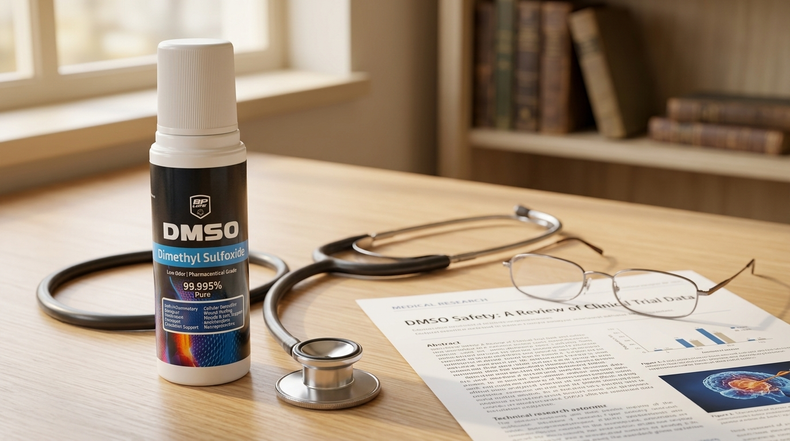
Is DMSO Safe? What the Research Says
By bb • BP Life • July 2026 • 7 min read
Safety is the first question most people ask before trying DMSO. It's a fair question — you're applying a compound to your skin that penetrates within minutes. This article covers what decades of research, clinical use, and published studies tell us about the safety profile of dimethyl sulfoxide.
Disclaimer: This article is for informational purposes only and is not medical advice. DMSO is FDA-approved for the treatment of interstitial cystitis. Other uses discussed here are based on published research or user-reported experiences. Always consult your healthcare provider before using DMSO.
IN THIS ARTICLE
DMSO's Track Record
DMSO is not new. It was first synthesized in 1866, and its biological properties have been studied since the 1960s — making it one of the most extensively researched topical compounds in existence. Thousands of peer-reviewed studies have been published on DMSO over the past six decades.
160+
Years since discovery
1000s
Published studies
1978
FDA-approved for IC
60+
Years of clinical use
In veterinary medicine, DMSO has been used for decades and is FDA-approved for use in horses and dogs. In human medicine, it's been administered in clinical settings as both a topical agent and a bladder wash.
What the FDA Says
The FDA approved DMSO in 1978 under the brand name Rimso-50 for the treatment of interstitial cystitis (a chronic bladder condition). This remains its only approved indication in the United States.
DMSO is also widely available over the counter as a topical product and research compound. The FDA has not restricted its sale — it simply hasn't approved it for other specific medical uses, largely because no company has funded the clinical trials needed for additional approvals (DMSO is off-patent and inexpensive, so there's no financial incentive).
"Not FDA-approved for X" is not the same as "FDA says it's unsafe." The absence of approval reflects a lack of funded clinical trials, not a finding of harm. DMSO's safety profile in research and clinical use is well-documented.
Known Side Effects
Like any bioactive compound, DMSO has side effects. The important thing is that they are well-characterized, generally mild, and temporary.
| Side Effect | How Common | Details |
|---|---|---|
| Garlic-like taste | Very common | Occurs within minutes of application. Caused by DMS, a harmless metabolite. Temporary. |
| Skin warmth/tingling | Common | Mild warming at the application site. Fades in 10-15 minutes. |
| Mild redness | Occasional | Temporary redness at the site. Usually resolves quickly. |
| Slight odor | Common | Faint garlic smell. Minimized with pharma-grade low-odor products. |
| Skin dryness | Occasional | Some users notice mild dryness with frequent use. Moisturize after full absorption. |
| Headache | Rare | Reported occasionally, usually with higher concentrations. |
Compare this to the side effect profiles of common over-the-counter pain relievers (NSAIDs), which carry documented risks of stomach bleeding, kidney damage, and cardiovascular events with long-term use. DMSO's side effects are mild by comparison.
What Research Shows About Safety
The published research on DMSO safety spans decades. Here are the key findings:
Toxicity Profile
DMSO has a remarkably low toxicity. The LD50 (the dose lethal to 50% of test subjects in animal studies) is extremely high compared to most pharmaceutical compounds, placing it in a very safe category. In studies involving oral, topical, and intravenous administration in animals, DMSO consistently demonstrated a wide safety margin.
Long-Term Use
Studies examining extended DMSO use have not identified cumulative toxicity. Patients treated with DMSO for interstitial cystitis have used it repeatedly over months and years under clinical supervision without reports of organ damage or systemic toxicity.
Eye Safety Concern (Debunked)
In the 1960s, early animal studies at very high oral doses reported lens changes in certain species (dogs and rabbits). This finding was widely publicized and contributed to regulatory caution. However:
- These effects occurred at doses far exceeding any human topical use
- Subsequent studies in primates (closer to humans) did not replicate the findings
- Decades of human clinical use have not produced documented cases of lens toxicity
- The FDA's own approval for interstitial cystitis came after these studies, suggesting the agency considered the risk minimal at therapeutic doses
Decades of clinical use and thousands of published studies have established DMSO as one of the safest topical compounds available.
The Carrier Effect — Why Purity Matters
DMSO's greatest strength is also the reason quality matters: it carries substances through the skin. This penetration-enhancing property means that anything on the surface of your skin — or any impurity in the DMSO itself — can be transported into your body.
SAFE PRACTICES
- Use 99.9%+ pharma-grade DMSO
- Apply only to clean, dry skin
- Use glass or HDPE containers
- Keep hands clean during application
- Buy from brands with third-party testing
SAFETY RISKS
- Low-purity or industrial-grade DMSO
- Applying over lotions, sunscreen, or meds
- Storing in incompatible plastics (PET, PVC)
- Using on broken or contaminated skin
- Unverified products without COA
Bottom line: DMSO itself is safe. The risk comes from what it carries. High purity and clean application eliminate virtually all safety concerns related to the carrier effect.
Read more: Best Pharma Grade DMSO — What to Look For →
Who Should Avoid DMSO
While DMSO is safe for most people, certain groups should exercise caution or avoid it:
How to Use DMSO Safely
✓ Choose 99.9%+ pharma-grade DMSO with third-party lab testing
✓ Always apply to clean, dry skin — no products underneath
✓ Wash hands before and after application
✓ Start with a small test area to check for sensitivity
✓ Use glass or HDPE containers only
✓ Dilute with distilled water if you have sensitive skin
✓ Let absorb 15-20 minutes before covering with clothing
✓ Store at room temperature in the original container
For a complete walkthrough: How to Use DMSO Topically: A Beginner's Guide →
Frequently Asked Questions
No. DMSO has an extremely low toxicity profile. It has been used in clinical settings for over 60 years. At recommended topical concentrations, it is well-tolerated with only mild, temporary side effects.
Early animal studies at very high oral doses reported lens changes in dogs and rabbits. These findings have not been replicated in primates or humans. Decades of clinical use in humans have not produced documented cases of eye damage. Do not apply DMSO directly to the eyes.
Many users apply DMSO daily without issues. Start with once-daily application and see how your skin responds. If there's no irritation, you can increase frequency. Always use pharmaceutical-grade purity.
DMSO can enhance the absorption of topical medications due to its carrier properties. If you're using prescription topical medications, consult your healthcare provider before using DMSO in the same area.
DMSO is off-patent and very inexpensive. Clinical trials for new drug indications cost hundreds of millions of dollars and are typically funded by pharmaceutical companies seeking patent-protected returns. No company has the financial incentive to fund trials for an off-patent compound.
Yes — significantly. Pharma-grade DMSO is 99.9%+ pure and tested for contaminants. Industrial-grade may contain impurities that DMSO would carry through your skin. Always use pharmaceutical-grade for topical application. Learn how to tell the difference →
The research is clear: pharmaceutical-grade DMSO, applied properly to clean skin, has one of the best safety profiles of any topical compound.
Shop BP Life DMSO — 99.9% Pure, Pharma Grade, 3rd Party Tested
4oz Glass Dropper 3oz Roll-On 8oz Glass BottleThis article is for informational and educational purposes only. It is not intended to diagnose, treat, cure, or prevent any disease. Consult your healthcare provider before starting any new wellness routine.