
How to Use DMSO Topically: A Beginner's Guide
By bb • BP Life • July 2026 • 8 min read
You bought your first bottle of DMSO — now what? If you're new to dimethyl sulfoxide, the idea of applying a powerful solvent to your skin can feel intimidating. But topical DMSO is straightforward once you understand a few key rules.
Disclaimer: This article is for informational purposes only and is not medical advice. DMSO is FDA-approved for the treatment of interstitial cystitis. Other uses discussed here are based on published research or user-reported experiences. Always consult your healthcare provider before using DMSO.
IN THIS ARTICLE
Why Skin Preparation Matters More with DMSO
Before we get into how to apply DMSO, you need to understand why preparation matters more here than with any other topical product.
DMSO penetrates the skin in minutes and carries whatever it touches along with it. That's what makes it powerful — and why clean application is non-negotiable.
This carrier property is what makes DMSO unique, but it also means that anything on the surface of your skin — lotion, sunscreen, dirt, soap residue — can be transported through the skin barrier and into your body.
Only apply DMSO to clean, dry, bare skin. No exceptions.
Step-by-Step: How to Apply DMSO Topically
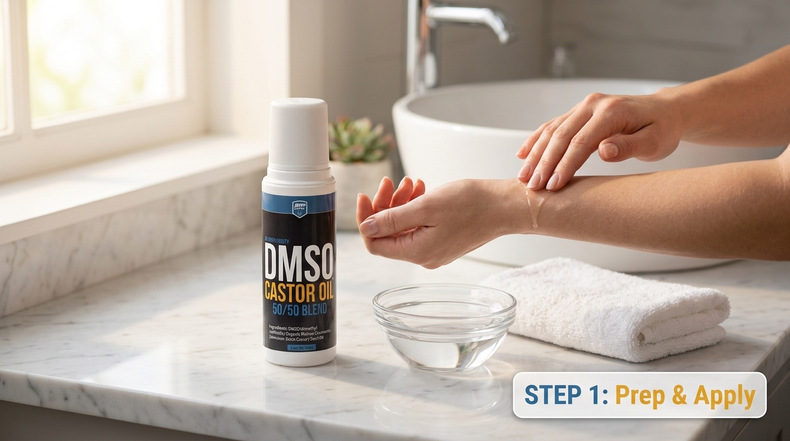
Clean the Application Area
Wash the area with plain water or a mild, fragrance-free soap. Rinse thoroughly to remove any soap residue. Pat completely dry with a clean towel.
Avoid: Scented soaps, exfoliating scrubs, and applying over any existing lotions or sunscreen.
Clean Your Hands
Wash your hands the same way — plain soap, rinsed well, dried completely. Whatever is on your hands when you handle DMSO can be carried through the skin.
Apply a Small Amount
Less is more, especially when you're starting out.
- Liquid DMSO: A few drops from the glass dropper. Spread gently in a thin, even layer.
- Roll-on DMSO: One or two passes over the area. The roller applies a controlled layer automatically.
You don't need to saturate the skin. A thin layer absorbs efficiently — more product doesn't mean faster results.
Let It Absorb
Leave the area uncovered for 15–20 minutes. Don't bandage, wrap, or put clothing over it right away.
You'll feel the skin start to dry within a few minutes. Once fully absorbed and dry to the touch, dress normally.
Wash Your Hands After
Wash with soap and water after applying. This prevents accidentally transferring DMSO to your eyes, mouth, or other sensitive areas.
What to Expect After Applying DMSO
First-time users are often surprised by a few of DMSO's trademark effects. All of these are normal and well-documented:
Warmth or Tingling
Mild warming at the site. Fades in 10–15 minutes. Not a sign of irritation.
Garlic-Like Taste
A taste in your mouth within minutes. It's your body metabolizing DMSO. Harmless and temporary.
Mild Redness
Slight redness at the site. Usually temporary. Persistent redness = discontinue and consult a doctor.
Slight Odor
Faint garlic smell. Pharma-grade low-odor DMSO minimizes this significantly.
DMSO Dilution: Do You Need to Dilute It?
Pure DMSO (99.9%) can be used directly on the skin, but many beginners prefer to start with a diluted concentration to see how their skin responds.
| Concentration | How to Mix | Best For |
|---|---|---|
| 50% | Equal parts DMSO + distilled water | Sensitive skin, facial area |
| 70% | 7 parts DMSO + 3 parts distilled water | General topical use, beginners |
| 90% | 9 parts DMSO + 1 part distilled water | Experienced users |
| 99.9% (pure) | No dilution needed | Experienced users, targeted areas |
Always use distilled water for dilution — never tap water. Tap water contains chlorine, fluoride, and minerals you don't want DMSO carrying through your skin. Mix in a clean glass or HDPE container only.
Expect warmth when mixing: DMSO + water produces a normal exothermic reaction. Let it cool before applying.
Where Can You Apply DMSO?
Common Application Sites
- Knees, elbows, wrists
- Shoulders and neck
- Lower back
- Forearms and calves
- Feet and ankles
Avoid These Areas
- Eyes and mucous membranes
- Open wounds or broken skin
- Areas with active rashes
- Over other topical products
How Often Can You Use DMSO?
There's no single "correct" frequency — it depends on your goals and skin response:
- 1–3 times per day for targeted areas
- Once daily for general maintenance
- As needed for occasional use
Start with once daily and increase gradually if there's no irritation.
Common Mistakes to Avoid
Popular DMSO Combinations
Because of its carrier properties, some users intentionally combine DMSO with other compounds to enhance absorption:
DMSO + Castor Oil
The most popular blend. Pre-mixed options available for convenience.
DMSO + Magnesium Oil
Users report enhanced absorption of topical magnesium.
DMSO + Aloe Vera
Can help soothe the area, especially for sensitive skin.
Only mix DMSO with substances you'd be comfortable having inside your body — because that's exactly where DMSO will take them.
Shop BP Life DMSO — 99.9% Pure, Pharma Grade, 3rd Party Tested
4oz Glass Dropper 3oz Roll-On 8oz Glass BottleQuick-Start Checklist
✓ Wash application area with mild soap → rinse thoroughly → dry completely
✓ Wash hands before handling DMSO
✓ Apply a thin layer — a few drops or one roll-on pass
✓ Leave uncovered for 15–20 minutes
✓ Wash hands after application
✓ Wait for full absorption before dressing
✓ Store in original container at room temperature
Frequently Asked Questions
Some users apply diluted DMSO (50% or lower) to the face, but facial skin is more sensitive. Start with a very small test area and a lower concentration. Avoid the eye area entirely.
DMSO itself is colorless and won't stain. However, if you mix it with colored substances, those could transfer. Let DMSO absorb fully before dressing.
Wait at least 20–30 minutes after application to allow full absorption. Washing too soon may reduce effectiveness.
No. It's caused by dimethyl sulfide (DMS), a harmless metabolite. It's temporary and fades within a few hours.
Both work great. Roll-on is easier for beginners (mess-free, controlled amount). Liquid gives more flexibility for dilution. Many users keep both. Read our full comparison →
Either works. Some apply before activity; others prefer post-workout. If applying before exercise, allow full absorption and ensure skin is dry before clothing contact.
Clean skin. Clean hands. Thin layer. Let it absorb.
That's really all there is to it.
This article is for informational and educational purposes only. It is not intended to diagnose, treat, cure, or prevent any disease. Consult your healthcare provider before starting any new wellness routine.