
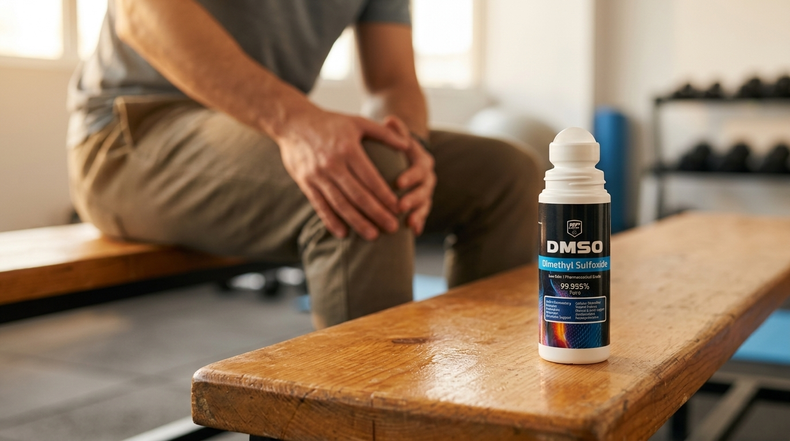
DMSO for Joint Discomfort: What Users Report and What Studies Show
By bb • BP Life • July 2026 • 8 min read
Joint discomfort is one of the most common reasons people turn to DMSO. Whether it's stiff knees, sore shoulders, or aching wrists, the appeal is simple: a topical compound that penetrates quickly and reaches the joint area directly, without the systemic side effects of oral pain medications.
This article covers what published research has found, what real-world users report, and how people are incorporating DMSO into their joint care routines.
Disclaimer: This article is for informational purposes only and is not medical advice. DMSO is FDA-approved only for interstitial cystitis. Claims about joint pain are based on published research and user-reported experiences, not FDA-approved indications. Always consult your healthcare provider.
IN THIS ARTICLE
Why People Use DMSO for Joints
DMSO has three properties that make it uniquely suited for joint-related applications:
Rapid Penetration
Passes through skin in minutes, reaching deeper tissue where joints hurt.
Anti-Inflammatory Properties
Research documents DMSO's ability to reduce inflammatory markers at the cellular level.
Analgesic Activity
Studies suggest DMSO can selectively block pain signals from small nerve fibers.
Unlike oral pain medications that circulate through the entire body, topical DMSO delivers these properties directly to the affected area.
What the Research Shows
DMSO has been studied specifically for musculoskeletal and joint-related applications in both animal and human studies:
Published Findings
- Anti-inflammatory action: Multiple studies have documented DMSO's ability to reduce inflammatory cytokines, scavenge free radicals, and help drain edema (swelling) that compresses tissues around joints.
- Pain signal modulation: Research shows DMSO selectively blocks pain signals from C fibers — small nerve fibers commonly involved in chronic pain conditions. This blocking effect is reversible and does not cause tolerance.
- Muscle relaxation: Studies have demonstrated DMSO's ability to relax skeletal muscles, which can reduce pain from tension and spasms around joints.
- Improved circulation: DMSO has been shown to increase blood flow to treated areas, which may help deliver nutrients to damaged tissue and accelerate natural healing processes.
While these findings are drawn from published, peer-reviewed research, DMSO is not FDA-approved for joint pain or arthritis. The research is promising but no large-scale clinical trials have been completed for these specific indications. Users apply DMSO for joint discomfort based on the available evidence and their own experience.
How DMSO May Help with Joint Discomfort
Based on the published research, DMSO appears to address joint discomfort through multiple mechanisms simultaneously:
| Mechanism | What It Does | Why It Matters for Joints |
|---|---|---|
| Reduces inflammation | Lowers inflammatory cytokines and scavenges free radicals | Inflammation is the primary driver of joint pain and stiffness |
| Blocks pain signals | Selectively blocks C fiber nerve conduction | Provides relief without the tolerance buildup of traditional painkillers |
| Relaxes muscles | Reduces skeletal muscle tension and spasms | Tight muscles around joints create compression and pain |
| Improves circulation | Increases blood flow to the treated area | Better circulation delivers nutrients and supports tissue repair |
| Drains edema | Helps reduce fluid buildup in tissue | Swelling around joints restricts movement and causes discomfort |
What makes DMSO unique is that it addresses multiple aspects of joint discomfort simultaneously — inflammation, pain signaling, muscle tension, and circulation — from a single topical application.
DMSO vs. Traditional Pain Relievers
Many people reach for over-the-counter NSAIDs (ibuprofen, naproxen) or acetaminophen for joint discomfort. Here's how DMSO compares:
| Factor | DMSO (Topical) | NSAIDs (Oral) |
|---|---|---|
| Delivery | Applied directly to the affected area | Circulates through entire body |
| Onset | Penetrates skin within minutes | 30-60 minutes to take effect |
| Stomach risk | No GI exposure | Can cause ulcers, bleeding with long-term use |
| Kidney risk | Not associated with kidney damage | Documented risk with long-term use |
| Tolerance | No documented tolerance buildup | Some users report diminishing effectiveness |
| Side effects | Garlic taste, mild skin warmth (temporary) | GI distress, cardiovascular risk, liver/kidney stress |
This comparison is not a recommendation to replace prescribed medication with DMSO. If you're currently using medication for joint pain, consult your healthcare provider before making any changes.
How to Apply DMSO to Joints
Clean the joint area
Wash and dry the skin over and around the affected joint. Remove any lotions, creams, or topical products.
Apply a thin layer of DMSO
Using a glass dropper (liquid) or roll-on applicator, apply DMSO directly over the joint. Cover the area around it too — not just the point of maximum discomfort.
Tip: For knees, apply to the front, sides, and behind the knee for best coverage.
Let it absorb completely
Wait 15-20 minutes before putting on clothing, knee sleeves, or braces. The area should feel dry to the touch.
Repeat as needed
Most users apply 1-3 times daily for ongoing joint discomfort, or as needed before/after physical activity.
For a complete application guide: How to Use DMSO Topically: A Beginner's Guide →
What Users Report
While individual experiences vary, the most commonly reported outcomes from DMSO users dealing with joint discomfort include:
Most Commonly Reported
- Noticeable improvement within the first few applications
- Reduced stiffness, especially in the morning
- Increased range of motion
- Ability to reduce reliance on oral painkillers
Common Use Cases
- Knee stiffness and discomfort
- Shoulder and rotator cuff soreness
- Elbow and wrist discomfort
- Post-workout joint recovery
- Age-related joint stiffness
These are user-reported experiences, not guaranteed outcomes. Individual results vary based on the nature and severity of the joint issue, consistency of application, and other factors. DMSO is not a cure for joint conditions.
Frequently Asked Questions
Many users report feeling some effect within 15-30 minutes of application. For more significant improvement, consistent daily use over several days to a week is commonly reported.
Yes, but wait until the DMSO has fully absorbed (15-20 minutes) before putting on the brace or sleeve. Make sure the brace material is clean.
Both work well. Roll-on is especially convenient for knees and elbows since it applies evenly without dripping. Liquid is better for getting broader coverage and allows dilution. Read our comparison →
Yes. Some users apply before workouts for pre-emptive support; others use it post-workout for recovery. Allow full absorption before putting on workout gear.
Long-term DMSO use has not been associated with cumulative toxicity in published research. Many users apply DMSO to their joints daily over extended periods. Always use pharmaceutical-grade purity. Read our safety guide →
DMSO is not a replacement for prescribed medication. If you're considering changing your treatment approach, discuss it with your healthcare provider. Many users incorporate DMSO as a complementary addition to their existing routine.
Shop BP Life DMSO — 99.9% Pure, Pharma Grade, 3rd Party Tested
4oz Glass Dropper 3oz Roll-On 8oz Glass BottleThis article is for informational and educational purposes only. It is not intended to diagnose, treat, cure, or prevent any disease. Consult your healthcare provider before starting any new wellness routine.