
What Is Zeolite? The Natural Mineral Behind Modern Detox Supplements
By bb | BP Life Editorial Team
Zeolite has become one of the most talked-about ingredients in the world of natural detox supplements. Born from the collision of volcanic ash and seawater over thousands of years, this remarkable mineral has an unusual molecular structure that has fascinated scientists and wellness enthusiasts alike. But what exactly is zeolite, how does its microscopic cage-like architecture work, and why has it earned a place in so many modern binder and detox formulas? This guide breaks down the science, the sourcing, and the practical considerations in plain language.
Disclaimer: This article is for informational and educational purposes only. The information provided does not constitute medical advice and is not intended to diagnose, treat, cure, or prevent any disease or health condition. Statements about zeolite reflect traditional wellness use and ongoing research and have not been evaluated by the Food and Drug Administration. Always consult a qualified healthcare professional before starting any new supplement or wellness routine.
Table of Contents
01 What Zeolite Actually Is
Zeolites are a family of naturally occurring minerals known as microporous aluminosilicates. In simpler terms, they are crystalline structures built primarily from aluminum, silicon, and oxygen atoms, arranged in a repeating three-dimensional framework riddled with tiny channels and cavities.
Most natural zeolites form where volcanic rock and ash react with alkaline groundwater or seawater over thousands to millions of years. The word "zeolite" itself comes from the Greek words meaning "boiling stone," a name coined in the 18th century by a Swedish mineralogist who observed that the mineral appeared to steam when heated because of the water trapped inside its pores.
There are dozens of distinct zeolite species, but the one most commonly used in wellness supplements is clinoptilolite. Clinoptilolite is prized because it is naturally abundant, has a well-characterized structure, and carries a long history of use in agriculture, water filtration, and dietary applications. When a supplement label simply says "zeolite," it almost always refers to clinoptilolite.
"The name 'zeolite' comes from Greek for 'boiling stone' — a nod to the water that steams out of its microscopic pores when the mineral is heated."
02 The Honeycomb Cage Structure
What makes zeolite so distinctive is its architecture. At the molecular level, silicon and aluminum atoms each sit at the center of a tetrahedron surrounded by four oxygen atoms. These tetrahedra link together at their corners to form an open, rigid framework — a honeycomb-like lattice full of uniform pores, channels, and interconnected cavities.
This porous framework gives zeolite an enormous internal surface area relative to its size. A single gram of clinoptilolite can contain a vast network of microscopic tunnels, all sized within a narrow, predictable range. Because the openings are so consistent, zeolites are sometimes called "molecular sieves" — they can selectively admit or exclude molecules and ions based purely on size and charge.
The other crucial feature is charge. Silicon carries a +4 charge and aluminum carries a +3 charge. Every time an aluminum atom takes the place of a silicon atom in the framework, it leaves the structure with a slight net negative charge. Across the entire crystal, these small negative charges add up, giving natural zeolite an overall negatively-charged internal surface.
Key Concept
Zeolite's framework carries a net negative charge because aluminum atoms substitute for some silicon atoms in the crystal lattice. That negative charge, combined with a honeycomb of uniform pores, is the foundation of everything zeolite is known for.
03 How Zeolite Binds Positively-Charged Ions
Nature tends toward electrical balance. Because zeolite's framework carries a net negative charge, it naturally attracts and holds positively-charged particles — called cations — to neutralize itself. In their natural state, zeolite pores are loosely occupied by common, harmless cations such as sodium, potassium, calcium, and magnesium.
These loosely held cations can be swapped out for others through a process called ion exchange. When zeolite encounters a solution containing positively-charged ions that it "prefers" more strongly, it releases its lightly-held sodium or potassium and captures the incoming ions in their place, trapping them within the honeycomb cage. This is the same principle used in water-softening systems and industrial filtration.
In the context of detox supplements, this ion-exchange behavior is the reason zeolite is often described as a natural "binder." Its negatively-charged internal surface is drawn to positively-charged ions, including certain metal ions, holding them within its structure. The uniform pore size also acts as a physical filter, admitting small ions while excluding larger molecules. It is important to frame this as a well-documented physical and chemical property of the mineral rather than a specific health outcome.
"Because opposite charges attract, zeolite's negatively-charged honeycomb naturally draws in and traps positively-charged ions through a process called ion exchange."
04 Natural vs. Synthetic Zeolite
Not all zeolite is created the same way. There are two broad categories, and the distinction matters when choosing a supplement.
Natural Zeolite
Mined from volcanic mineral deposits, then cleaned and processed. Clinoptilolite is the natural form used in most dietary supplements. Because it comes from the earth, sourcing and purity testing are essential to ensure it is free from unwanted contaminants.
Synthetic Zeolite
Manufactured in a laboratory with tightly controlled pore sizes and compositions. Synthetic zeolites are used heavily in industry — detergents, catalysts, gas separation — but are less common in wellness products, where the naturally occurring clinoptilolite form is generally preferred.
For dietary and wellness applications, natural clinoptilolite is the standard. Its long history of use, well-mapped structure, and abundance make it the go-to choice. The key with natural zeolite is that quality depends heavily on where it is mined and how carefully it is processed and tested — a theme we return to below.
05 Common Wellness Uses
Zeolite has a broad footprint far beyond the supplement aisle. It is widely used in water purification, air filtration, agriculture, animal feed, and even in cat litter — all applications that take advantage of its ability to trap ions, moisture, and odor molecules within its porous structure.
Within the wellness world, clinoptilolite zeolite is most commonly marketed as a supplement that may support the body's natural detoxification processes. Because its properties are rooted in the mineral's physical structure, these products are typically framed around traditional use and ongoing research rather than specific medical outcomes. Commonly cited reasons people explore zeolite include:
- General detox support — as a binder that may support the body's natural elimination pathways
- Gut and digestive wellness — an area of active research interest
- Everyday mineral supplementation — zeolite naturally contains trace minerals within its framework
It is worth emphasizing that research into zeolite's role in human health is ongoing, and much of the enthusiasm is grounded in the mineral's documented ion-binding chemistry rather than large-scale clinical proof of specific benefits. Anyone considering zeolite should view it as one part of a broader wellness approach and consult a healthcare professional.
06 Quality and Purity Considerations
Because natural zeolite is a mined mineral, quality varies significantly from source to source and product to product. If you are evaluating a zeolite supplement, a few factors separate high-quality products from questionable ones:
- Contaminant testing — reputable products are lab-tested to confirm they are free from unwanted heavy metals and other impurities that can occur in raw mineral deposits
- Particle size — the physical size of the zeolite particles influences how the mineral behaves; consistent, well-controlled particle sizing is a marker of careful processing
- Activation and cleaning — quality zeolite is cleaned and "activated" to clear the pores of debris so the ion-exchange sites are open and available
- Source transparency — trustworthy brands disclose where their zeolite is mined and provide certificates of analysis
- Clinoptilolite content — higher-quality products specify the percentage of actual clinoptilolite rather than mixed mineral filler
The takeaway is straightforward: with a mined mineral, testing and transparency are everything. A zeolite product is only as good as the sourcing and quality controls behind it.
Important Note
Always look for a zeolite supplement that publishes third-party lab testing for purity. Because zeolite is drawn from natural mineral deposits, verified contaminant testing is the single most important quality signal — it confirms the product is clean and safe for its intended use.
07 Forms Available: Powder and Liquid
Zeolite supplements generally come in two main forms, each with its own characteristics:
Powder
Micronized zeolite powder can be mixed into water or other liquids. Powders often provide a larger amount of mineral per serving and let users control their own dosing. Particle size and thorough cleaning are especially important considerations for powder products.
Liquid Drops
Liquid formulas suspend very fine zeolite particles in water, taken by the dropperful. They are convenient and easy to dose consistently. Quality here depends heavily on the fineness of the particles and the purity of the base zeolite used.
Neither form is universally "better" — the right choice depends on personal preference, convenience, and, above all, the quality and testing behind the specific product. A well-sourced, lab-tested product in either format is preferable to a cheaper, untested alternative.
08 How Zeolite Fits in a Detox Routine
Within the natural wellness space, zeolite is often grouped with other "binders" — ingredients whose porous or charged structures allow them to attract and hold onto various substances. Activated charcoal, bentonite clay, and zeolite each work through related but distinct mechanisms, and they are sometimes used together in comprehensive detox support formulas.
Zeolite's particular niche is its selective ion-exchange behavior: its uniform pores and negative charge give it an affinity for specific positively-charged ions. Many people who explore zeolite do so as one component of a broader routine that also emphasizes hydration, whole foods, fiber, quality sleep, and support for the body's own detoxification organs such as the liver.
That liver connection is why zeolite frequently appears alongside liver-support ingredients in modern wellness stacks. The liver is central to how the body processes and eliminates unwanted compounds, so many detox-minded routines pair a binder like zeolite with targeted liver support to address the process from multiple angles. As always, this should be viewed as a general wellness approach rather than treatment for any specific condition.
09 Frequently Asked Questions
What is zeolite made of?
Zeolite is a microporous aluminosilicate mineral — a crystalline framework built mostly from aluminum, silicon, and oxygen. Natural zeolites form when volcanic ash and rock react with alkaline water over long periods. The variety used in most supplements is called clinoptilolite.
How does zeolite bind to heavy metals?
Zeolite's crystal framework carries a net negative charge, so it naturally attracts positively-charged ions, including certain metal ions. Through a process called ion exchange, zeolite releases loosely-held ions like sodium and captures other cations, trapping them within its honeycomb pores. This is a documented physical and chemical property of the mineral.
Is natural or synthetic zeolite better for supplements?
For dietary and wellness use, natural clinoptilolite is the standard choice because of its long history of use and well-understood structure. Synthetic zeolites are more common in industrial applications. With natural zeolite, the most important factor is careful sourcing, cleaning, and contaminant testing.
What should I look for in a quality zeolite product?
Look for third-party lab testing that confirms purity and freedom from contaminants, clear disclosure of the source, consistent particle sizing, proper activation, and a stated clinoptilolite content. Because zeolite is a mined mineral, verified testing and transparency are the most important signals of quality.
Should zeolite be taken as a powder or liquid?
Both forms are common. Powders offer flexible dosing and often more mineral per serving, while liquid drops are convenient and easy to dose consistently. The best choice comes down to personal preference and, most importantly, the quality and testing behind the specific product. Consult a healthcare professional before adding any new supplement to your routine.
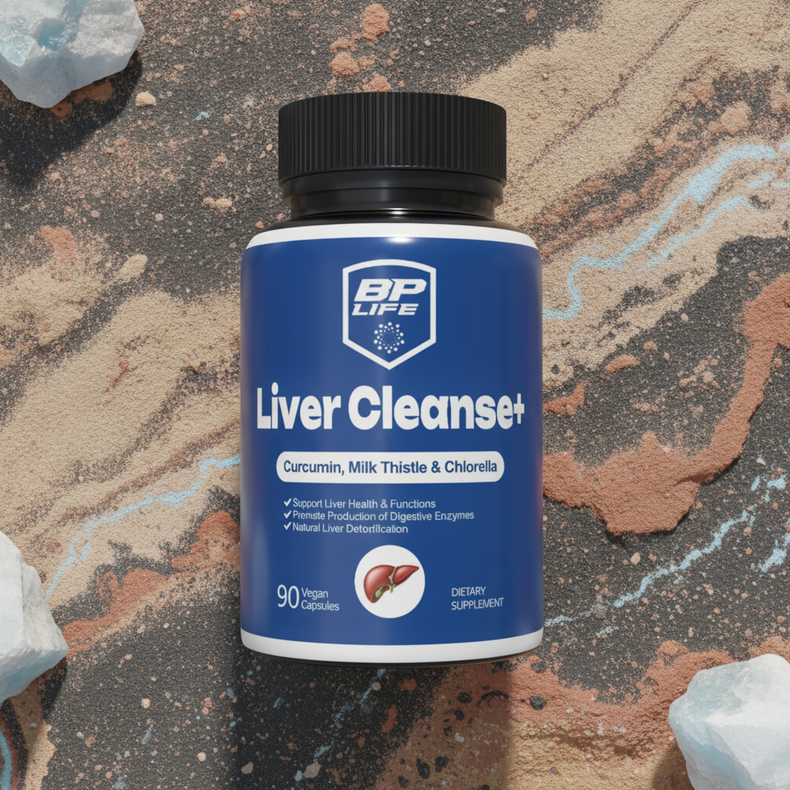
BP Life Liver Cleanse+ Detox Support
Support your body's natural detoxification pathways with BP Life Liver Cleanse+, thoughtfully formulated for everyday wellness and quality you can trust.
Explore Liver Cleanse+Continue Reading
Disclaimer: This article is for informational and educational purposes only. Nothing on this page constitutes medical advice. Statements regarding zeolite reflect traditional wellness use and ongoing research and have not been evaluated by the Food and Drug Administration. BP Life products are not intended to diagnose, treat, cure, or prevent any disease. Always consult a licensed healthcare provider before beginning any new supplement or wellness routine.