
What Is Fenbendazole? A Complete Beginner's Guide
By bb | BP Life Editorial Team
If you've spent any time in wellness forums, health podcasts, or alternative research communities lately, you've likely come across one question that keeps coming up: what is fenbendazole? Once confined entirely to veterinary medicine, fenbendazole has become one of the most-searched compounds in the wellness space. This guide breaks down exactly what it is, where it came from, why it's gaining attention, and what you need to know before exploring it further.
Disclaimer: This article is for informational and educational purposes only. The information provided does not constitute medical advice and is not intended to diagnose, treat, cure, or prevent any disease or health condition. BP Life products are not evaluated by the Food and Drug Administration. Always consult a qualified healthcare professional before starting any new supplement or wellness routine.
Table of Contents
What Is Fenbendazole?
Fenbendazole is a benzimidazole compound — a class of molecules characterized by a benzene ring fused to an imidazole ring. It has been used in veterinary medicine for decades as an antiparasitic agent, primarily to address intestinal parasites in animals ranging from dogs and cats to horses, livestock, and even some exotic species.
Its molecular formula is C15H13N3O2S, and it is classified as a broad-spectrum benzimidazole carbamate. In practical terms, this means it belongs to a family of compounds with a long, well-documented safety record in animals. It is commonly sold under brand names such as Panacur and Safe-Guard for veterinary use.
"Fenbendazole has been used safely in veterinary medicine since the 1970s — its documented profile across multiple species is part of what drives wellness community interest today."
Veterinary Origins and History
Fenbendazole was first developed and introduced in the 1970s as part of a broader era of benzimidazole drug development. The benzimidazole class proved highly effective against a wide range of parasitic worms (helminths), including roundworms, hookworms, whipworms, and certain tapeworm species.
For decades, it has been a workhorse of large-animal and small-animal veterinary practice. Dog owners recognize it as the active ingredient in Panacur C dewormer packets. It's also widely used in food-animal agriculture to maintain the health of cattle, sheep, and goats. Because of its extensive use across species, fenbendazole has one of the longest real-world safety datasets of any compound in this class.
This long history in veterinary medicine — combined with published academic research exploring its biological mechanisms — is a key reason why researchers and members of the wellness community began examining it more closely around 2019 and 2020.
Chemical Properties
Understanding what is fenbendazole at a chemical level helps explain why researchers have found it interesting beyond its original antiparasitic applications. Here are the key properties:
Mechanism
Disrupts microtubule polymerization by binding to beta-tubulin.
Solubility
Poorly water-soluble; fat-soluble. Often taken alongside a fatty meal for better absorption.
Class
Benzimidazole carbamate — same class as albendazole and mebendazole.
Formula
C15H13N3O2S | Molecular weight: 299.35 g/mol
The beta-tubulin binding mechanism is what makes fenbendazole interesting to researchers beyond its antiparasitic role. Microtubules are critical structures in many cellular processes — not just in parasites. This has led academic researchers to investigate what this binding affinity might mean in other biological contexts.
Why Is Fenbendazole Trending?
The modern surge in public interest in fenbendazole traces back to one individual's story — Joe Tippens, a man who shared his personal wellness experience publicly in 2019 after being told he had a terminal diagnosis. His account went viral, and millions of people — particularly in South Korea, where mainstream media coverage was extensive — began researching the compound. You can read the full story in our dedicated article: The Joe Tippens Protocol: Fenbendazole and the Story Behind It.
Beyond the anecdotal story, a growing number of peer-reviewed academic studies — particularly out of South Korea and the United States — have examined fenbendazole in laboratory settings. While none of this research constitutes clinical proof of any medical application, the volume of published interest has sustained public attention and driven a community of self-experimenting wellness users who share their experiences openly online.
Forms Available
Fenbendazole is available in several formats, each with its own practical trade-offs. The main forms you'll encounter are:
- Bulk Powder — Raw fenbendazole powder, measured by weight. Lowest cost per dose, most flexibility. Requires a precise milligram scale.
- Capsules — Pre-measured doses in white vegetarian capsules. Most convenient for consistent, on-the-go use.
- Granules / Sachets — Common in veterinary products (e.g., Panacur C). Less common as a human-use format.
- Paste — Primarily a large-animal veterinary format. Not typically used in wellness contexts due to concentration and formulation differences.
For a detailed side-by-side comparison of powder vs. capsules, see: Fenbendazole Powder vs. Capsules: Which Form Is Right for You?
How People Are Using Fenbendazole
The wellness community has developed several popular approaches to using fenbendazole. The most widely discussed is the so-called "Tippens Protocol" — though it is important to note this is not a medically approved protocol and is based on personal experimentation, not clinical guidelines. See our article on the Joe Tippens protocol for the full breakdown.
Community-reported usage patterns frequently discuss:
- Doses in the 222mg range, taken on a cyclical schedule (most commonly 3 days on, 4 days off)
- Pairing with a fat source (such as MCT oil or a fatty meal) due to fenbendazole's fat-soluble nature
- Stacking with other supplements such as vitamin E succinate and berberine — though none of these combinations have established clinical evidence
- Some users opt for 444mg doses — see our article on 222mg vs. 444mg differences
We strongly encourage all readers to consult with a qualified healthcare professional before beginning any new supplement routine involving fenbendazole. The information on this page reflects community usage patterns only and is not a recommendation.
BP Life Fenbendazole Products
BP Life offers fenbendazole in multiple formats to serve different preferences and budgets:
100G Bulk Powder
$0.17 / 222mg dose
Best value for long-term or high-volume use. Requires a milligram-accurate scale.
50G Bulk Powder
$0.36 / 222mg dose
A good starting size for those new to powder form before committing to larger quantities.
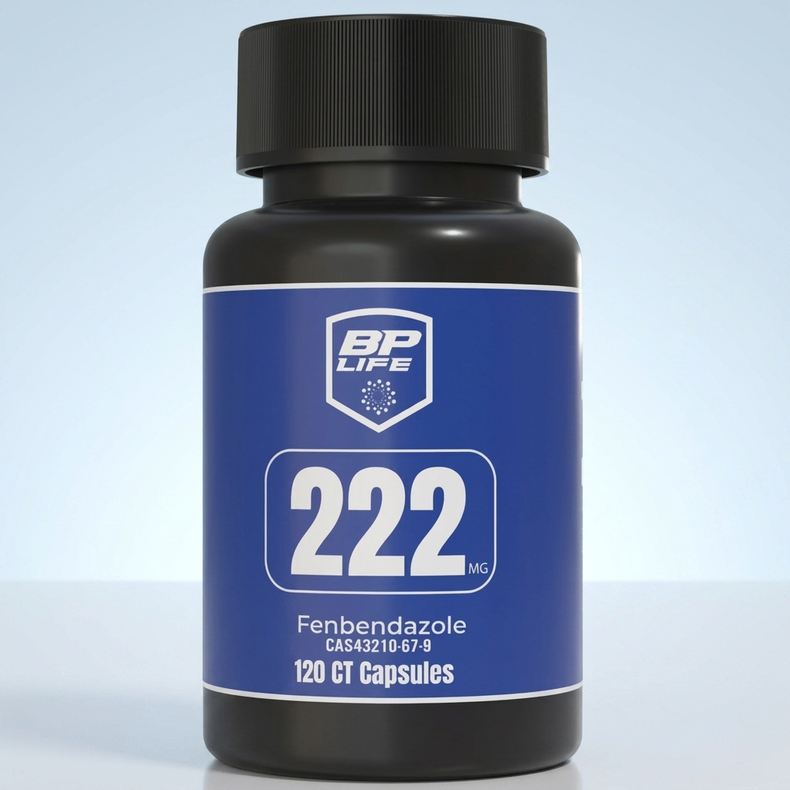
120ct Capsules 222mg
$0.62 / dose
Pre-measured white capsules. Maximum convenience — no scale needed.
120ct Capsules 444mg
Double-strength option
For those who prefer a 444mg dose in a single white capsule. Compare options in our 222mg vs 444mg guide.
Wholesale (1KG) quantities are also available for practitioners or volume buyers. Visit shopbplife.com to explore the full catalog.
Frequently Asked Questions
What is fenbendazole used for?
Fenbendazole is primarily used in veterinary medicine as a broad-spectrum antiparasitic agent for animals. It has also attracted growing interest from the wellness community based on published laboratory research and widely shared personal accounts.
Is fenbendazole safe for humans?
Fenbendazole has a long safety record in veterinary use across multiple animal species. However, it is not approved by the FDA as a drug for use in humans. Anyone considering fenbendazole should consult a healthcare professional. BP Life products are sold as research-grade compounds, not as medical treatments.
What class of compound is fenbendazole?
Fenbendazole is a benzimidazole carbamate. It belongs to the same chemical class as albendazole and mebendazole and works by binding to beta-tubulin to disrupt microtubule formation in target organisms.
What forms does BP Life fenbendazole come in?
BP Life offers fenbendazole as bulk powder (100G and 50G) and as pre-measured white capsules (120ct at 222mg and 120ct at 444mg). Wholesale 1KG quantities are also available.
Why do people take fenbendazole with fat?
Fenbendazole is poorly soluble in water but fat-soluble. Taking it alongside a fatty meal or fat source such as MCT oil is a common practice in the wellness community, believed to support absorption — though this has not been formally studied in clinical human trials.
Continue Reading
Disclaimer: This article is for informational and educational purposes only. Nothing on this page constitutes medical advice. BP Life fenbendazole products are not intended to diagnose, treat, cure, or prevent any disease or health condition and have not been evaluated by the Food and Drug Administration. Always consult a licensed healthcare provider before beginning any new wellness routine.