
A Timeline of DMSO Research: From Paper Mills to Modern Wellness
By bb | BP Life Editorial Team
Few compounds in the history of science have traveled a stranger path than DMSO. First synthesized in a 19th-century Russian chemistry lab, dimethyl sulfoxide spent nearly a century as a forgotten industrial byproduct before one accidental discovery catapulted it into the spotlight. Its story involves paper mills, organ transplant surgeons, a media frenzy, FDA controversy, and a worldwide research effort that continues to this day. Here is the complete timeline.
Disclaimer: This article is for informational and educational purposes only. The information provided does not constitute medical advice and is not intended to diagnose, treat, cure, or prevent any disease or health condition. BP Life products are not evaluated by the Food and Drug Administration. Always consult a qualified healthcare professional before starting any new supplement or wellness routine.
Table of Contents
- 1866 — Discovery in Kazan, Russia
- 1940s–1950s — Industrial Awakening
- 1950s — The Cryoprotection Breakthrough
- 1960s — Dr. Stanley Jacob and the Paper Mill Connection
- 1963–1965 — Global Excitement and Media Frenzy
- 1965–1970s — The FDA Clampdown
- 1978 — Limited FDA Approval
- 1980s–Present — Global Research Continues
- Why This History Matters Today
- BP Life DMSO Products
- Frequently Asked Questions
01 1866 — Discovery in Kazan, Russia
The story of DMSO begins in 1866, when Russian chemist Alexander Saytzeff first synthesized dimethyl sulfoxide at the University of Kazan on the Volga River. He noted that the substance was colorless, had a faint garlic-like odor, felt oily to the touch, and left an unusual aftertaste reminiscent of shellfish. Beyond recording these observations, Saytzeff saw little practical use for the compound. DMSO would remain a laboratory curiosity for the better part of a century.
"Saytzeff described DMSO as colorless, oily, and garlic-scented — observations that would prove remarkably accurate 160 years later."
02 1940s–1950s — Industrial Awakening
DMSO finally attracted serious attention in the mid-20th century — not from the medical community, but from the paper industry. During the Kraft pulping process, wood is broken down into cellulose fibers, producing a sulfur-rich waste stream called black liquor. Chemists discovered that dimethyl sulfide (DMS) could be extracted from this waste, then oxidized into DMSO.
Crown Zellerbach, one of America's largest paper companies, set up a research facility in Camas, Washington specifically to find commercial uses for tree pulp byproducts. Their chemists began exploring DMSO's extraordinary solvent capabilities — it could dissolve an unusually wide range of organic and inorganic substances — and early animal testing suggested a surprisingly favorable safety profile.
03 1950s — The Cryoprotection Breakthrough
In the 1950s, British researchers made a critical discovery: DMSO could protect living cells from ice crystal damage during freezing and thawing. This made DMSO one of the first effective cryoprotectants — substances that allow biological material to survive ultra-low temperatures. Blood cells, bone marrow, and eventually organ tissue could be preserved using DMSO solutions, opening entirely new possibilities in biology and transplant medicine.
This cryoprotective property is still used in laboratories worldwide today. When hospitals freeze stem cells or bone marrow for transplant, DMSO is the standard protective agent added to the sample. It was this very application that would draw the attention of an ambitious young surgeon in Oregon.
04 1960s — Dr. Stanley Jacob and the Paper Mill Connection
The pivotal chapter in DMSO history belongs to Dr. Stanley W. Jacob, a surgeon and organ transplant researcher at the Oregon Health & Science University (then the University of Oregon Medical School). In 1962, Jacob was searching for a way to preserve transplant kidneys without ice crystal damage and turned to DMSO as a potential cryopreservative.
He contacted Robert Herschler, a chemist at Crown Zellerbach's paper mill research facility, to obtain pharmaceutical-grade DMSO. During their experiments, Jacob noticed something no one had documented before: when DMSO contacted his skin, he could taste it on his breath within minutes. The compound was passing directly through his skin and entering his bloodstream — a property virtually unknown among chemical solvents at the time.
Jacob and Herschler quickly realized the implications. If DMSO could carry itself through the skin, it might be able to carry other therapeutic compounds through the skin as well. They also discovered that DMSO appeared to reduce pain and inflammation on its own. The partnership between a university surgeon and a paper mill chemist would become one of the most unlikely collaborations in medical research history.
"The discovery that DMSO could pass through intact skin — carrying itself and other substances directly into the bloodstream — was one of the most unexpected findings in pharmacological history."
05 1963–1965 — Global Excitement and Media Frenzy
In 1963, Jacob and Herschler published their first findings, introducing DMSO's biological properties to the scientific community. The response was immediate and intense. Within two years, thousands of doctors and researchers around the world were testing DMSO on conditions ranging from arthritis, burns, and sprains to spinal cord injuries and neurological disorders.
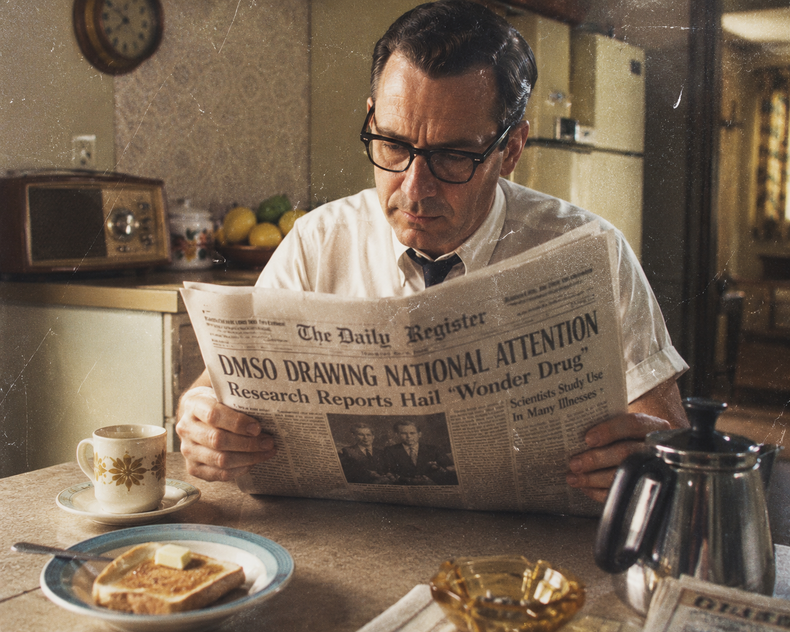
Media coverage amplified the excitement. Newspapers and television programs described DMSO as a "miracle drug" and a "wonder solvent." By 1965, more than 100,000 patients had reportedly been treated with DMSO by an estimated 1,500 physicians. The pace was extraordinary — few compounds in history had generated such rapid, widespread clinical interest.
But the speed of adoption also raised red flags. DMSO had skipped the traditional path of slow, methodical clinical trials. Regulators grew increasingly uneasy, particularly after animal studies at certain doses showed temporary changes in the refractive index of eye lenses in some species.
06 1965–1970s — The FDA Clampdown
In November 1965, the U.S. Food and Drug Administration effectively shut down all clinical investigations of DMSO, restricting its use to carefully controlled research settings only. The official concern was the eye lens findings in animal studies, although the changes were later found to be temporary and species-specific — they were not replicated in human studies.
The timing was particularly unfortunate. The thalidomide crisis was still fresh in the public memory, and the FDA was under enormous pressure to demonstrate regulatory vigilance. DMSO, with its explosive and largely uncontrolled adoption, became a high-profile target. Many researchers felt the crackdown was disproportionate, and DMSO would later be described by the Yale Journal of Biology and Medicine as "the persecuted drug."
Despite the restrictions, research continued internationally. Scientists in Germany, Russia, Japan, and other countries published hundreds of studies documenting DMSO's anti-inflammatory, analgesic, and antioxidant properties. Meanwhile, the veterinary world adopted DMSO without hesitation — it became a standard treatment for inflammation, trauma, and swelling in horses, dogs, and livestock throughout the 1970s.
"The Yale Journal of Biology and Medicine famously called DMSO 'the persecuted drug' — a compound with vast documented potential held back by regulatory caution and industry politics."
07 1978 — Limited FDA Approval
After more than a decade of debate, the FDA approved DMSO for one specific human condition: interstitial cystitis, a chronic and painful bladder disorder. The approved formulation, marketed as Rimso-50, remains the only FDA-sanctioned human use of DMSO in the United States to this day. Supporters of DMSO viewed the narrow approval as a compromise that fell far short of the compound's documented potential.
Around the same time, Dr. Jacob and his colleagues at Oregon began investigating methylsulfonylmethane (MSM), a naturally occurring metabolite of DMSO. MSM would go on to become widely available as a nutritional supplement for joint support — a legacy of the original DMSO research that few consumers are aware of.
08 1980s–Present — Global Research Continues
Outside the United States, DMSO has been approved in several countries for conditions including arthritis, pain management, and inflammation. Thousands of peer-reviewed studies have documented its antioxidant activity, its ability to scavenge free radicals, its anti-inflammatory effects, and its unique capacity to act as a transdermal carrier for other compounds.
In 2010, commercial production methods shifted. The traditional process of extracting dimethyl sulfide from paper mill lignin was largely replaced by synthesis from methanol and hydrogen sulfide, reflecting broader changes in the chemical industry. The DMSO produced today is chemically identical regardless of manufacturing origin.
Interest in DMSO has resurged dramatically in recent years. Online wellness communities have fueled renewed attention, and a growing body of published research continues to explore applications in areas ranging from tissue protection and neurological support to pain management and cellular biology. Dr. Stanley Jacob, who passed away in 2015 at age 91, dedicated more than 50 years of his career to DMSO research — making him, by many accounts, the single most important figure in the compound's modern history.
09 Why This History Matters Today
Understanding the history of DMSO is important for anyone exploring it today. This is not a newly invented compound with limited data — it has more than 160 years of documented history, thousands of published studies, and a well-characterized safety profile across multiple species. Its regulatory story is also a reminder that a compound's legal status and its scientific evidence do not always move at the same pace.
For consumers, the key takeaway is that DMSO's long track record provides a foundation of data that few wellness compounds can match. Whether you're using it topically for comfort, as a carrier alongside other products, or simply exploring the published research, knowing where DMSO came from gives you better context for making informed decisions.
DMSO at a Glance
Synthesized by Alexander Saytzeff in Kazan, Russia
Industrial chemists explore DMSO's solvent properties
Cryoprotection breakthrough — cells survive freezing with DMSO
Dr. Stanley Jacob discovers transdermal penetration at Oregon
First scientific publication — DMSO introduced to the medical community
FDA restricts all DMSO clinical trials
FDA approves DMSO for interstitial cystitis (Rimso-50)
Production shifts from paper mill lignin to methanol synthesis
Dr. Stanley Jacob passes away at 91, having dedicated 50+ years to DMSO research
10 BP Life DMSO Products
At BP Life, we offer pharmaceutical-grade DMSO (99.9% purity) in two convenient formats designed for topical application:
DMSO Liquid
99.9% pharmaceutical-grade dimethyl sulfoxide in liquid form. Versatile for topical application and easy to measure for custom dilutions.
DMSO Roll-On
The same pharmaceutical-grade DMSO in a convenient roll-on applicator. No mess, no measuring — designed for targeted topical application on the go.
Explore BP Life DMSO → shopbplife.com/dmso
11 Frequently Asked Questions
Who discovered DMSO?
DMSO was first synthesized in 1866 by Russian chemist Alexander Saytzeff at the University of Kazan. Its biological and medical properties were later explored by Dr. Stanley Jacob at Oregon Health & Science University beginning in 1962.
Where does DMSO come from?
DMSO was historically produced as a byproduct of the paper pulping industry, extracted from the sulfur-rich waste stream of the Kraft process. Modern production uses methanol and hydrogen sulfide as feedstocks. The resulting compound is chemically identical.
Is DMSO FDA approved?
DMSO is FDA-approved for one human condition: interstitial cystitis (under the brand name Rimso-50). It is also widely used in cryopreservation and as an industrial solvent. BP Life DMSO products are sold for topical and research use.
Why was DMSO called "the persecuted drug"?
This phrase comes from a publication in the Yale Journal of Biology and Medicine. It refers to the disconnect between DMSO's extensive published research and its very limited regulatory approval in the U.S., which many researchers attributed to political and industry factors rather than safety or efficacy concerns.
What is the connection between DMSO and MSM?
MSM (methylsulfonylmethane) is a naturally occurring metabolite of DMSO. Dr. Stanley Jacob and his colleagues discovered that MSM shares some of DMSO's properties. Today MSM is widely sold as a nutritional supplement, particularly for joint support — a direct legacy of the original DMSO research at Oregon.
Continue Reading
Disclaimer: This article is for informational and educational purposes only. Nothing on this page constitutes medical advice. BP Life DMSO products are not intended to diagnose, treat, cure, or prevent any disease or health condition and have not been evaluated by the Food and Drug Administration. Always consult a licensed healthcare provider before beginning any new wellness routine.