
By bb • BP Life • July 2026 • 7 min read
MCT oil is everywhere in health and fitness circles, but most people don't realize that not all MCTs are equal. C8 MCT oil -- pure caprylic acid -- is the most efficient medium-chain triglyceride for producing ketones, and it works fundamentally differently from the blended MCT oils that dominate store shelves.
These statements have not been evaluated by the Food and Drug Administration. This product is not intended to diagnose, treat, cure, or prevent any disease.
This guide breaks down what C8 actually is, how it works in your body, and why the distinction matters.
What Are Medium-Chain Triglycerides?
Triglycerides are fat molecules made up of glycerol and three fatty acid chains. The "chain length" refers to how many carbon atoms each fatty acid contains. Long-chain triglycerides (LCTs), found in most dietary fats, have 12 or more carbons and require bile salts and pancreatic enzymes for digestion.
Medium-chain triglycerides have 6 to 12 carbon atoms. This shorter structure changes everything about how your body processes them. MCTs bypass much of the normal digestive process, traveling directly to the liver via the portal vein, where they're rapidly converted into energy or ketone bodies.
The Four Types of MCTs
Not all medium-chain triglycerides behave the same way. Here's how they compare:
| MCT Type | Name | Carbons | Ketone Efficiency | Notes |
|---|---|---|---|---|
| C6 | Caproic acid | 6 | Fast but harsh | Causes GI distress; rarely used alone |
| C8 | Caprylic acid | 8 | Highest | Fastest usable ketone production |
| C10 | Capric acid | 10 | Moderate | Slower conversion than C8 |
| C12 | Lauric acid | 12 | Low | Behaves more like a long-chain fat |
C8 sits in the sweet spot: fast enough to produce ketones within minutes, but without the stomach issues that C6 causes. C12 (lauric acid) is technically classified as an MCT by chain length, but it's digested more like a long-chain fat and doesn't produce significant ketones.
How C8 Works in Your Body
When you consume C8 MCT oil, the process is remarkably direct:
Rapid absorption -- C8 is absorbed through the intestinal wall without needing bile salts
Direct liver transport -- It travels via the portal vein straight to the liver, bypassing the lymphatic system
Ketone conversion -- The liver converts C8 into beta-hydroxybutyrate (BHB) and acetoacetate within minutes
Available energy -- Ketones enter the bloodstream and fuel your brain, muscles, and organs
This process happens whether or not you're following a ketogenic diet. C8 produces ketones even in the presence of carbohydrates, though the effect is stronger in a low-carb state.
C8 caprylic acid converts to ketones approximately 3x faster than C10 and produces measurably higher blood ketone levels per gram consumed.
C8 vs. Blended MCT Oils
The majority of MCT oils sold today are blends -- typically a mix of C8 and C10, sometimes with C12 added to reduce cost. Here's why that matters:
- Ketone output: Pure C8 produces higher peak blood ketone levels than C8/C10 blends at the same dose
- Speed: Blended oils convert more slowly because C10 takes longer to metabolize
- Value: Products containing C12 are padding the bottle with a cheaper ingredient that doesn't deliver meaningful MCT benefits
- Stomach tolerance: Pure C8 tends to be easier on the digestive system than blends containing C6 or high C10 ratios
If a label says "MCT oil" without specifying the fatty acid breakdown, it's almost certainly a blend. Look for products that list 100% C8 or 100% caprylic acid.
Who Benefits from C8 MCT Oil?
C8 MCT oil has practical applications beyond the keto community:
- Ketogenic dieters -- Reliable ketone production to support and deepen ketosis
- Intermittent fasters -- Quick energy during fasting windows without spiking insulin
- Athletes -- Fast-acting fuel that doesn't require glycogen, useful for endurance activities
- Anyone seeking mental clarity -- Ketones are an efficient fuel source for the brain, and many users report improved focus
- Supplement users -- MCT oil improves absorption of fat-soluble compounds like fenbendazole and certain vitamins
What to Look for When Buying C8 MCT Oil
Not all C8 MCT oils are created equal. Here's what separates a quality product:
- 100% C8 (caprylic acid) -- No blending with C10 or C12
- Coconut-sourced -- Coconut-derived MCTs have a cleaner profile than palm-derived alternatives, and avoid the environmental concerns associated with palm oil
- Organic certification -- Ensures the coconut source meets organic farming standards
- No additives -- No fillers, flavors, or emulsifiers
- Transparent labeling -- The fatty acid breakdown should be clearly listed, not hidden behind "proprietary blend"
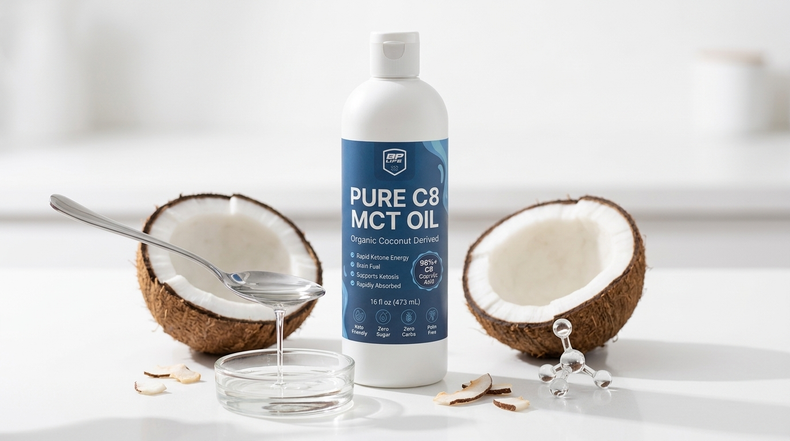
BP Life's Organic C8 MCT Oil -- 100% caprylic acid from organic coconuts. No blends, no fillers.
Shop C8 MCT OilFrequently Asked Questions
Is C8 MCT oil the same as coconut oil?
No. Coconut oil contains roughly 6-8% caprylic acid (C8), along with large amounts of lauric acid (C12) and other long-chain fats. C8 MCT oil is an extracted, concentrated form -- pure caprylic acid without the other fatty acids.
Can I take C8 MCT oil if I'm not on a keto diet?
Yes. C8 produces ketones regardless of your carbohydrate intake. The effect is stronger in a low-carb state, but many non-keto users take MCT oil for energy, focus, or supplement absorption.
How much C8 MCT oil should I take per day?
Most people start with 1 teaspoon (about 5ml) and gradually increase to 1-2 tablespoons (15-30ml). Starting too high can cause digestive discomfort. Give your body a week to adjust at each dose level.
Does C8 MCT oil break a fast?
Technically yes -- it contains calories (about 130 per tablespoon). However, it doesn't spike insulin and promotes ketone production, so many intermittent fasters include it during their fasting window. Whether it "breaks" your fast depends on your fasting goals.
Why is C8 MCT oil more expensive than regular MCT oil?
Caprylic acid makes up only about 6-8% of coconut oil. Extracting and concentrating it requires more processing than simply blending C8, C10, and C12 together. The higher cost reflects the higher purity and effectiveness.
These statements have not been evaluated by the Food and Drug Administration. This product is not intended to diagnose, treat, cure, or prevent any disease.