
By bb • BP Life • July 2026 • 6 min read
If you've been shopping for MCT oil, you've probably noticed some products list C8, some list C10, and many just say "MCT oil" without specifying which type. The difference isn't just marketing -- C8 and C10 are distinct fatty acids with different metabolic pathways, absorption speeds, and practical effects.
These statements have not been evaluated by the Food and Drug Administration. This product is not intended to diagnose, treat, cure, or prevent any disease.
Here's what the research shows and how to decide which one fits your goals.
Quick Comparison
| Property | C8 (Caprylic Acid) | C10 (Capric Acid) |
|---|---|---|
| Carbon chain length | 8 carbons | 10 carbons |
| Ketone production speed | Very fast (minutes) | Moderate (slower onset) |
| Peak blood ketone level | Higher | Lower |
| % of coconut oil | ~6-8% | ~8-10% |
| Cost | Higher (more processing) | Lower |
| Stomach tolerance | Generally good | Generally good |
| Best for | Maximum ketones, mental clarity | Sustained energy, budget-friendly |
What Is C8 (Caprylic Acid)?
C8, or caprylic acid, is an 8-carbon medium-chain fatty acid. It's the shortest MCT that's practical to consume (C6 exists but causes significant stomach distress). After ingestion, C8 bypasses normal fat digestion entirely -- it doesn't require bile salts or pancreatic enzymes. Instead, it travels directly to the liver via the portal vein, where it's rapidly converted into ketone bodies.
This direct metabolic pathway is why C8 produces ketones faster than any other dietary fat. Blood ketone levels typically rise within 15-30 minutes of consumption.
What Is C10 (Capric Acid)?
C10, or capric acid, has 10 carbon atoms -- just two more than C8. That small structural difference has a measurable impact on metabolism. C10 still absorbs faster than long-chain fats, but its slightly longer chain means it takes a detour through more metabolic steps before reaching ketone conversion.
The result: C10 produces ketones, but more slowly and at lower peak levels than C8. On the positive side, C10 is more abundant in coconut oil (about 8-10% vs 6-8% for C8), which makes it less expensive to extract.
Ketone Production: Head to Head
The key practical difference between C8 and C10 comes down to ketone output:
- Speed: C8 raises blood ketone levels approximately 3x faster than C10 after ingestion
- Peak levels: C8 produces measurably higher peak BHB (beta-hydroxybutyrate) levels per gram consumed
- Duration: C10's ketone elevation lasts slightly longer, creating a more gradual energy curve
If your primary goal is maximum ketone production in minimum time, C8 is the clear winner. If you want a slower, more sustained effect, C10 has a role to play.
Digestion and Tolerance
Both C8 and C10 are generally well-tolerated when introduced gradually. Common advice applies to both:
- Start with 1 teaspoon and work up over 1-2 weeks
- Take with food initially to reduce any GI sensitivity
- Some people find pure C8 slightly easier on the stomach than C10, though individual responses vary
Tip
If you experience digestive discomfort with MCT oil, the most common cause is taking too much too soon. Reduce your dose and increase gradually.
What About C8/C10 Blends?
Many MCT oils on the market are C8/C10 blends, typically in a 60/40 or 70/30 ratio. These are less expensive to produce than pure C8 and offer a middle ground on ketone production.
The tradeoff is straightforward: blends produce fewer ketones than pure C8, but cost less per bottle. They're a reasonable option for general use, but if you're optimizing for ketone levels -- particularly for cognitive performance or deep ketosis -- pure C8 delivers more value per serving.
Watch out for products that include C12 (lauric acid) in their blend. C12 is technically classified as an MCT by chain length, but it's metabolized more like a long-chain fat and contributes minimal ketone production. It's often added because it's the cheapest MCT to source.
Which Should You Choose?
Choose pure C8 if:
- You want maximum ketone production per serving
- Mental clarity and focus are primary goals
- You're on a strict ketogenic protocol
- You use MCT oil to enhance absorption of fat-soluble supplements
- You're willing to pay slightly more for a concentrated product
Choose C10 or a blend if:
- Budget is the primary concern
- You want a slower, more sustained energy release
- You're using MCT oil primarily for cooking or recipes
- You're new to MCT oil and want to experiment before committing to C8
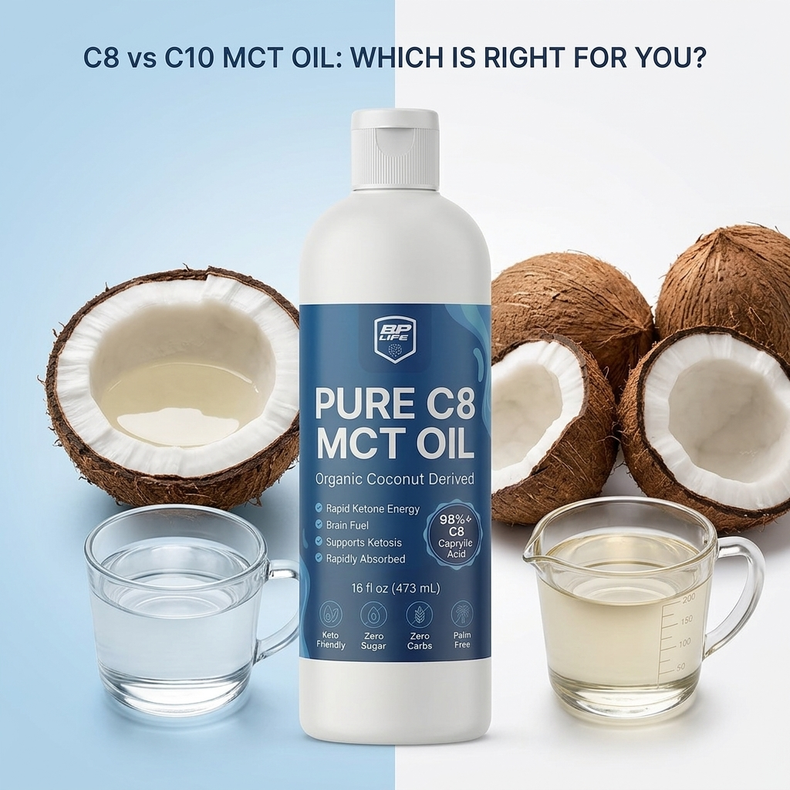
BP Life's Organic C8 MCT Oil is 100% caprylic acid from organic coconuts -- no C10 or C12 blending.
Shop C8 MCT OilFrequently Asked Questions
Can I mix C8 and C10 MCT oils myself?
You could, but there's no practical advantage over buying a pre-made blend. If you want the benefits of both, a quality C8/C10 blend works fine. If you want maximum ketone output, stick with pure C8.
Is C10 MCT oil bad?
Not at all. C10 is a legitimate medium-chain triglyceride that produces ketones and provides energy. It's just slower and less potent than C8 for ketone production.
Why don't most brands sell pure C10?
There's less demand for isolated C10 because C8 outperforms it on the primary metric most buyers care about (ketone production). C10 is more commonly found in blended MCT oils.
Does the source (coconut vs palm) affect C8 and C10 quality?
The extracted fatty acids are chemically identical regardless of source. The difference is environmental: palm oil production is associated with deforestation, while coconut sourcing is generally more sustainable. BP Life uses exclusively coconut-derived MCTs.
These statements have not been evaluated by the Food and Drug Administration. This product is not intended to diagnose, treat, cure, or prevent any disease.