
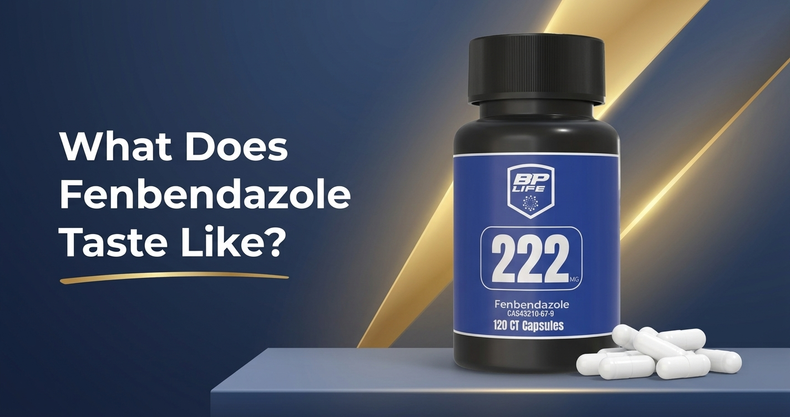
What Does Fenbendazole Taste Like? Pure Powder vs. Animal Products
By bb • BP Life • July 2026 • 6 min read
It's one of the most common questions from first-time buyers: what does fenbendazole actually taste like? The answer depends entirely on what form you're using — and whether you're getting pure fenbendazole or an animal dewormer product loaded with additional ingredients.
The short answer: pure fenbendazole powder is virtually tasteless and odorless. If you've heard people complain about a bad taste, they're almost certainly using veterinary products like Panacur C or Safe-Guard — which are only 22.2% fenbendazole. The other 78% is fillers, binders, and palatability additives designed to make dogs eat it.
Disclaimer: This article is for informational and educational purposes only. Fenbendazole is a veterinary compound. BP Life products are sold for research and laboratory use only. No medical claims are made or implied. Consult your healthcare provider for any health-related decisions.
IN THIS ARTICLE
What Pure Fenbendazole Tastes Like
Pure fenbendazole — meaning the isolated compound at 99%+ purity — has virtually no taste and no odor. It's a fine white powder with a consistency similar to confectioner's sugar or cornstarch.
If you were to place pure fenbendazole powder on your tongue, you would notice:
Taste
Essentially none. Some describe an extremely faint, slightly chalky or neutral quality — but most people report no discernible taste at all.
Odor
None. Pure fenbendazole has no noticeable smell when you open the container.
Texture
Very fine, light powder. Does not dissolve in water but mixes easily with food or can be encapsulated.
This is consistent with what researchers and chemists would expect. Fenbendazole is a benzimidazole compound with very low water solubility — it doesn't readily interact with taste receptors on the tongue. The compound itself is pharmacologically bland.
Pure fenbendazole is virtually tasteless and odorless. If your fenbendazole has a strong flavor, the taste is coming from whatever else is in the product — not the fenbendazole itself.
Why Animal Products Taste Different
If you've read forum posts or Facebook group comments about fenbendazole tasting bad, chalky, gritty, or unpleasant, the person is almost certainly describing an animal dewormer product — not pure fenbendazole.
Products like Panacur C (by Merck) and Safe-Guard are veterinary dewormers formulated specifically for dogs. They contain fenbendazole as the active ingredient, but the majority of the product by weight is inactive ingredients — fillers, binders, and palatability enhancers designed to make dogs willingly eat the powder when it's mixed into their food.
These inactive ingredients are what people taste. Not the fenbendazole.
Panacur C Granules are labeled as 22.2% fenbendazole. That means nearly 78% of the product is something other than fenbendazole — grain-based fillers, binders, and flavor-enhancing additives formulated to appeal to a dog's palate.
What's Actually in Panacur C and Safe-Guard?
Veterinary fenbendazole products are designed with one goal: get a dog to eat it. Dogs are notoriously picky about medications, so manufacturers add ingredients to mask any pill-like quality and make the powder palatable when mixed with kibble.
The inactive ingredients in products like Panacur C typically include:
| Ingredient Category | Purpose | Present in Pure Fenbendazole? |
|---|---|---|
| Wheat middlings / grain fillers | Bulk carrier — provides volume and a food-like texture that dogs accept | No |
| Lactose / milk derivatives | Palatability enhancer — adds a slightly sweet, food-like flavor for animals | No |
| Flavor additives | Makes the product taste acceptable to dogs when mixed with food | No |
| Binding agents | Holds the granule structure together for consistent dosing | No |
| Anti-caking agents | Prevents clumping during storage | No |
These ingredients are safe for dogs — that's their intended audience. But they contribute the grainy, wheat-like, slightly stale taste that people report. You're tasting dog food additives, not fenbendazole.
Veterinary products are manufactured under animal-grade quality standards, not pharmaceutical-grade human standards. The fillers and additives are selected for animal palatability and cost-effectiveness — not for human consumption or precise research applications.
Pure Powder vs. Animal Product: Side-by-Side
| Property | Pure Fenbendazole Powder (99%+) | Panacur C / Safe-Guard (22.2%) |
|---|---|---|
| Fenbendazole content | 99%+ pure compound | 22.2% — less than a quarter is fenbendazole |
| Taste | Virtually tasteless | Grainy, wheat-like, slightly stale or chalky |
| Odor | None | Faint grain/feed smell |
| Texture | Very fine, smooth powder | Coarser granules with visible grain particles |
| Color | White to off-white | Tan / beige (from grain fillers) |
| Inactive ingredients | None | Wheat middlings, lactose, flavor additives, binders |
| Intended for | Research and laboratory use | Canine deworming |
| Dosing precision | High — what you measure is what you get | Low — must calculate the 22.2% active content |
| Lab testing (3rd party) | Available from quality suppliers | Not typically provided to consumers |
With veterinary products, nearly 4 out of every 5 grams you're consuming is grain filler and flavor additives — not fenbendazole.
Why Purity Matters Beyond Taste
Taste is actually the least important reason to care about what's in your fenbendazole. The real issues with using veterinary products instead of pure powder include:
Dosing Accuracy
With a 22.2% product, a "1 gram" measurement only contains 222mg of actual fenbendazole. With 99%+ pure powder, 1 gram is essentially 1 gram of fenbendazole. Pure powder eliminates the math and the margin for error.
Unnecessary Additives
Wheat middlings, lactose, and flavor compounds serve no purpose outside of making dogs eat the product. If you're using fenbendazole for research, there's no reason to include animal feed ingredients.
Allergen Concerns
Wheat middlings contain gluten. Lactose is a milk derivative. These are common allergens that are present in veterinary products but absent from pure fenbendazole powder.
Quality Standards
Veterinary products are manufactured under animal-grade regulations. Research-grade fenbendazole from reputable suppliers undergoes third-party lab testing for purity and identity verification.
Capsules vs. Powder: The Taste Factor
If taste is a concern at all — even the very mild, near-neutral quality of pure powder — capsules eliminate it entirely.
Pure Powder
- Virtually tasteless, but you do interact with the powder
- Can be mixed with food, yogurt, or olive oil
- Flexible dosing — measure any amount you need
- Most cost-effective per milligram
- Best for: researchers who want custom measurements
Capsules
- Zero taste — powder is sealed inside a capsule shell
- Swallow with water like any supplement
- Pre-measured doses (222mg or 444mg)
- Most convenient — no measuring, no mixing
- Best for: convenience and consistency
Both formats from BP Life contain the same 99%+ pure fenbendazole. The only difference is delivery method and convenience.
Explore our options: Fenbendazole Capsules → | Fenbendazole Powder →
Frequently Asked Questions
Pure fenbendazole powder (99%+) has virtually no taste. Reports of bad taste almost always come from veterinary products like Panacur C, which contain wheat fillers, lactose, and flavor additives that make up nearly 78% of the product.
Panacur C has a grainy, wheat-like taste with a slightly stale or chalky quality. This flavor comes from the inactive ingredients (wheat middlings, lactose, binders) — not from the fenbendazole itself. Many people mask it by mixing with peanut butter or yogurt.
Panacur C is only 22.2% fenbendazole. The remaining 78% is grain-based fillers and palatability enhancers formulated to make dogs eat the product. When you taste Panacur C, you're tasting dog food additives, not fenbendazole.
Capsules are the easiest — zero taste, pre-measured, swallow with water. Powder is nearly tasteless too but requires measuring and can be mixed with food. Both forms are simple to use; capsules are just more convenient.
No. Fenbendazole has very low water solubility. It won't dissolve in water or juice. It can be mixed (suspended) in liquids or food, but it will settle to the bottom if left standing. For better absorption, research suggests pairing it with a fat source like olive oil or yogurt.
Pure fenbendazole powder has no noticeable odor. Veterinary products may have a faint grain or feed-like smell from the inactive ingredients.
The bottom line: fenbendazole itself is tasteless. If there's a flavor, it's coming from whatever else is in the product. Pure is pure — nothing added, nothing to taste.
Shop BP Life Fenbendazole — 99%+ Pure, Lab Tested, No Fillers
222mg Capsules 444mg Capsules Pure PowderThis article is for informational and educational purposes only. BP Life fenbendazole products are sold for research and laboratory use only. Not for human or animal consumption. No medical claims are made or implied.