
MCT Oil vs. Coconut Oil: Understanding the Difference
By bb | BP Life Editorial Team
MCT oil and coconut oil are often mentioned in the same breath, and for good reason: MCT oil is usually made from coconut. But they are not interchangeable. This article explains how they differ, when to use each, and why the distinction matters. It is educational only and makes no medical claims.
Disclaimer: This article is for informational and educational purposes only. The information provided does not constitute medical advice and is not intended to diagnose, treat, cure, or prevent any disease or health condition. Statements reflect traditional wellness use and ongoing research and have not been evaluated by the Food and Drug Administration. Always consult a qualified healthcare professional before starting any new supplement or wellness routine.
Table of Contents
1 How They Are Related
Coconut oil and MCT oil are close relatives. Coconut oil naturally contains a significant amount of medium-chain triglycerides, and most MCT oil on the market is extracted from coconut oil. In that sense, MCT oil is like a concentrated fraction of what coconut oil already contains. The difference is in what gets left behind.
Think of MCT oil as a focused extract of the fastest-acting fats in coconut oil, with the slower fats removed.
2 The Key Difference: Fat Composition
Coconut oil is a mixture of many fats. Roughly half of it is lauric acid, with smaller amounts of true medium-chain fats like caprylic (C8) and capric (C10) acids, plus some long-chain fats. MCT oil, by contrast, is concentrated: it isolates the C8 and C10 fats and discards most of the rest.
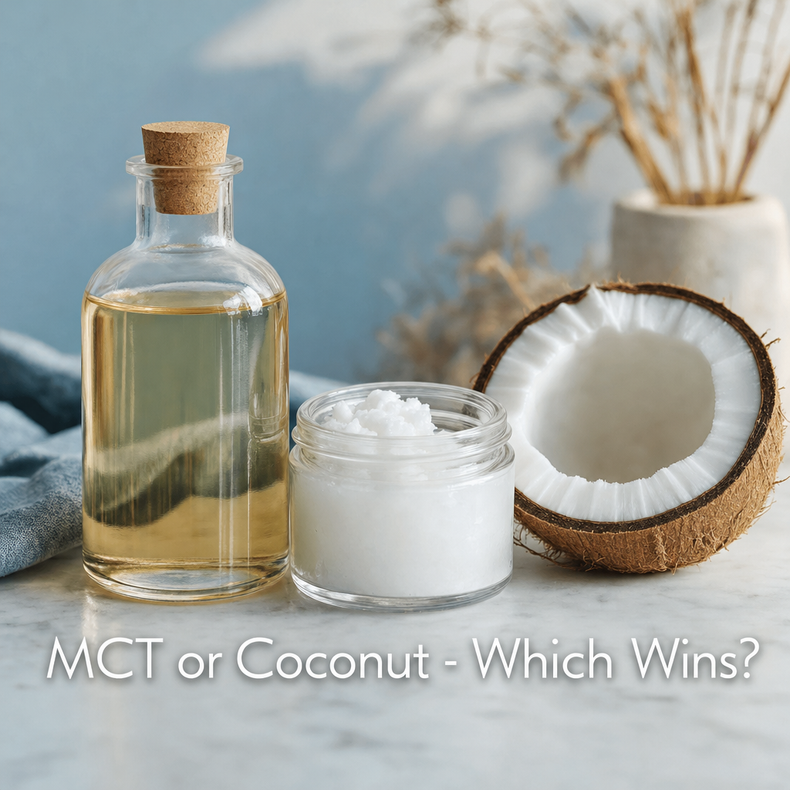
Coconut Oil
A whole-food fat that is solid below about 76F. Roughly 50 percent lauric acid, with modest amounts of C8 and C10 and some long-chain fats. Rich coconut flavor.
MCT Oil
A concentrated liquid that stays liquid at room temperature. Primarily C8 and/or C10, with little to no lauric or long-chain fat. Nearly flavorless.
This is why a tablespoon of MCT oil delivers far more fast-acting medium-chain fat than a tablespoon of coconut oil, even though both come from the same source.
3 The Lauric Acid Question
Lauric acid is where much of the confusion lives. Technically it is classified as a medium-chain fatty acid because it has 12 carbons. In practice, the body treats lauric acid more like a long-chain fat: it is digested more slowly and does not convert to ketones as readily as C8 or C10.
That means coconut oil, despite being marketed as high in MCTs, delivers less of the rapid-energy effect people associate with MCT oil. If quick energy and ketone support are the goal, concentrated C8 or C10 oil is the more direct route.
The Takeaway on Lauric Acid
Coconut oil is high in lauric acid, which behaves like a long-chain fat. If you want the fast-energy, ketone-supporting properties people talk about, a concentrated C8 MCT oil delivers them far more efficiently.
4 Energy and Ketones
Because MCT oil concentrates the fats that convert to ketones most readily, it is the stronger choice for anyone pursuing fast energy or ketone support on a low-carb diet. Coconut oil can contribute, but you would need to consume a large amount to match the medium-chain content of a single serving of MCT oil, and that comes with a lot of extra calories and flavor.
5 Cooking and Everyday Use
Here the two switch roles. Coconut oil has a higher smoke point and a rich flavor that makes it excellent for cooking, baking, and sauteing. MCT oil has a low smoke point and should not be used for high-heat cooking. Instead, it shines when stirred into already-prepared foods:
- Coconut oil: Sauteing, roasting, baking, and recipes where coconut flavor is welcome.
- MCT oil: Coffee, smoothies, salad dressings, yogurt, and anything you do not want to heat.
A simple rule of thumb: cook with coconut oil, blend MCT oil into things that are already made.
6 Which One Should You Choose?
The honest answer is that they serve different purposes and many people keep both. Choose coconut oil when you want a flavorful cooking fat and whole-food simplicity. Choose MCT oil when you want concentrated, fast-acting energy with no flavor and no cooking, especially on a keto or low-carb plan.
If your main interest is the energy and ketone benefits, a pure C8 product like BP Life Organic C8 MCT Oil gives you the active fraction without the filler, something no jar of coconut oil can match spoon for spoon.
7 Frequently Asked Questions
Is MCT oil better than coconut oil?
Neither is universally better; they serve different purposes. MCT oil is better for concentrated fast energy and ketone support, while coconut oil is better for high-heat cooking and flavor.
Can I use coconut oil instead of MCT oil in coffee?
You can, but the texture and flavor differ and you will get far fewer fast-acting medium-chain fats. MCT oil blends more smoothly and is nearly flavorless.
Why is lauric acid treated differently?
Although lauric acid is technically a medium-chain fat, the body digests it more like a long-chain fat, so it does not convert to ketones as quickly as C8 or C10.
Does coconut oil contain MCTs?
Yes, coconut oil naturally contains medium-chain fats, including C8 and C10, but a large portion of it is lauric acid and long-chain fats, so the true fast-acting MCT content is lower than in concentrated MCT oil.
Can I cook with MCT oil?
MCT oil has a low smoke point and is not suited to high-heat cooking. Use it in coffee, smoothies, dressings, and other no-heat applications, and use coconut oil for cooking.
BP Life Organic C8 MCT Oil
BP Life Organic C8 MCT Oil is pure caprylic acid sourced from organic coconuts, with transparent sourcing and third-party lab testing. No fillers, no blends, no shortcuts. Just clean, single-chain MCT energy you can trust.
Explore BP Life MCT OilContinue Reading
Disclaimer: This article is for informational and educational purposes only. Nothing on this page constitutes medical advice. Statements reflect traditional wellness use and ongoing research and have not been evaluated by the Food and Drug Administration. BP Life products are not intended to diagnose, treat, cure, or prevent any disease. Always consult a licensed healthcare provider before beginning any new supplement or wellness routine.