
The Joe Tippens Protocol: Fenbendazole and the Story Behind It
By bb | BP Life Editorial Team
If you've been researching fenbendazole, you've almost certainly encountered the name Joe Tippens. His story is the reason millions of people across the world began asking about this veterinary compound in the first place. This article tells that story factually, explains what the community-discussed "Joe Tippens protocol" involves, reviews the current state of academic research, and is clear — throughout — about what is established fact versus what remains anecdotal and unproven. This is not a promotion of an unapproved treatment. It is an honest account of a story that reshaped a wellness community.
Important Disclaimer: This article documents a personal account and its impact on the wellness community. It is strictly for informational and educational purposes. Nothing in this article constitutes medical advice. The Joe Tippens protocol is not a clinically proven treatment for any disease. Fenbendazole is not approved by the FDA to diagnose, treat, cure, or prevent any health condition in humans. Please consult a qualified healthcare professional before making any decisions related to your health or supplement use.
Table of Contents
Who Is Joe Tippens?
Joe Tippens is an American man who, in 2016, was diagnosed with small-cell lung cancer that had spread extensively throughout his body. He has described being told by his oncologist that he had approximately three months to live. By any clinical measure at the time of his diagnosis, his prognosis was considered terminal.
Tippens had spent much of his career in the oilfield and construction industries. He was not a scientist, a physician, or a medical researcher. He was, in his own telling, a man who had received a devastating diagnosis and chose to try anything that might help while also participating in a clinical trial for a new drug.
The Story That Started It All
According to Joe Tippens' account — shared publicly on his blog "My Cancer Story Rocks" and in numerous interviews — a veterinarian acquaintance suggested he try fenbendazole. The acquaintance claimed to have come across research suggesting fenbendazole might have properties beyond antiparasitic use. Tippens began taking fenbendazole alongside a combination of other supplements, including vitamin E succinate (in the tocopherol form), CBD oil, and curcumin, while simultaneously participating in an immunotherapy clinical trial.
In 2019, roughly three years after his terminal diagnosis, Tippens published his story publicly. He reported that his scans showed no evidence of cancer. His account quickly spread online, initially in the United States, and then explosively in South Korea, where it was covered by major mainstream media outlets and generated millions of online discussions.
It is important to note that Tippens was simultaneously enrolled in an immunotherapy clinical trial during the period he took fenbendazole. What role — if any — each element of his regimen played in his outcome cannot be determined from his personal account alone.
What Happened Next: Global Spread
The reach of Tippens' story was extraordinary. In South Korea, where it went viral in late 2019, the story sparked a national conversation. Korean oncologists began reporting patients asking about fenbendazole. The Korean government's Ministry of Food and Drug Safety issued guidance. Academic medical centers began taking notice — and beginning to study the compound more formally.
In the United States, wellness forums, cancer support communities, and alternative health platforms became active hubs for sharing variations of the protocol. Online communities grew into the tens of thousands of members, with individuals sharing their own experiences, adjustments, and observations.
By the early 2020s, fenbendazole had become one of the most-searched compounds in the wellness and alternative health space globally — a remarkable trajectory for a veterinary dewormer that had been available for decades without generating significant mainstream attention.
What the Protocol Involves
The "Joe Tippens protocol" as described and discussed in the wellness community typically includes the following elements. We present this as documentation of community practices — not as medical guidance or a recommendation.
Fenbendazole
222mg daily, 3 days on / 4 days off. Taken with a fat source for absorption.
Vitamin E Succinate
Tocopheryl succinate form, taken alongside fenbendazole days. Note: succinate form, not standard vitamin E.
CBD Oil
Included in Tippens' original account. Dosage discussed varies widely in community versions.
Curcumin / Turmeric
Included in many community variations of the protocol. Standard supplemental doses discussed.
The 3-days-on/4-days-off cycling schedule is the most consistent element across protocol descriptions. The rationale community members give for this cycling — borrowing from veterinary deworming schedules — is to allow the body a rest period between doses. This has no clinical evidence base for human application.
For more detail on the 222mg dose amount and how it compares to 444mg, see: Fenbendazole 222mg vs. 444mg: Understanding the Difference.
Critical reminder: The Joe Tippens protocol is a community-described practice based entirely on one individual's personal experience. It is not a clinical trial result, not an approved medical protocol, and not a recommendation from BP Life. Please work with your healthcare provider before considering any aspect of this protocol.
Current Research Status
The academic interest in fenbendazole — particularly following the viral spread of the Tippens story — is real and growing. A notable 2019 study published in Scientific Reports by researchers at Johns Hopkins examined fenbendazole in laboratory settings and found interesting activity in cell lines. South Korean universities and medical institutions have published multiple papers examining fenbendazole's biological mechanisms, primarily in vitro (cell culture) and in animal models.
Key points about where the research currently stands:
- In vitro evidence: Multiple published papers have examined fenbendazole in cell culture settings and noted various biological activities. This is early-stage science.
- Animal model studies: Some research has examined effects in animal models. Results have been mixed and context-dependent.
- No completed human clinical trials: As of this writing, there are no published, peer-reviewed randomized controlled trials (RCTs) demonstrating fenbendazole's efficacy in human disease.
- Ongoing academic interest: Research continues, particularly out of South Korean institutions, and more formal investigation is being discussed in academic circles.
- Mechanistic plausibility: Fenbendazole's mechanism of action — beta-tubulin binding — has led researchers to explore what that might mean in other cellular contexts. This is an area of legitimate scientific curiosity.
To understand the foundational science behind fenbendazole and why researchers find it interesting, see our article: What Is Fenbendazole? A Complete Beginner's Guide.
What We Don't Know
Honest engagement with the Tippens story requires being direct about its limitations as evidence:
- Causation cannot be established: Joe Tippens was simultaneously participating in an immunotherapy clinical trial. The role of fenbendazole, the immunotherapy drug, the other supplements, spontaneous remission, or any combination of these factors cannot be isolated from a single anecdotal case.
- Selection bias in community reports: People who experience positive outcomes are far more likely to share their stories publicly than those who do not. Online wellness communities naturally skew toward reporting successes.
- No dose-response data: There is no established human dose-response relationship for fenbendazole in any medical context. Community doses are extrapolated from veterinary applications.
- Interaction effects unknown: How fenbendazole interacts with specific medications, medical treatments, or individual health conditions in humans is not well characterized.
- Long-term safety data is limited: While fenbendazole has a strong veterinary safety profile, long-term daily use in humans has not been formally studied.
BP Life and Fenbendazole
BP Life exists to serve the wellness community with high-quality, accurately labeled fenbendazole products at transparent, competitive pricing. We do not make health claims, we do not claim our products treat any disease, and we do not sell hope. We sell a compound that adults — informed by their own research and, ideally, their own healthcare providers — have chosen to explore.
Our fenbendazole products include:
- 100G Bulk Powder — $0.17 per 222mg dose (lowest cost available)
- 50G Bulk Powder — $0.36 per 222mg dose
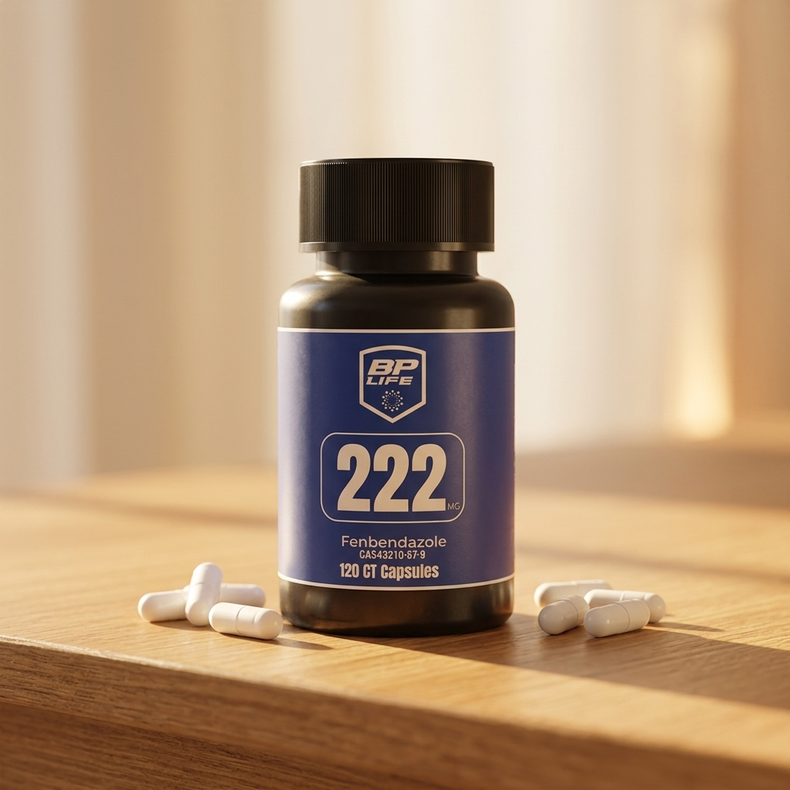
- 120ct White Capsules at 222mg — $0.62 per dose
- 120ct White Capsules at 444mg
- 1KG Wholesale for practitioners and volume buyers
Visit shopbplife.com to explore all options. If you're comparing forms, see our practical guide: Fenbendazole Powder vs. Capsules: Which Form Is Right for You?
Frequently Asked Questions
What is the Joe Tippens protocol?
The Joe Tippens protocol is a community-described supplement regimen based on the personal experience of Joe Tippens, who shared publicly that he took fenbendazole (222mg, 3 days on/4 days off), vitamin E succinate, CBD oil, and curcumin after receiving a terminal cancer diagnosis in 2016. It is not a clinically proven protocol and is not approved by any medical authority.
Did the Joe Tippens protocol work?
Joe Tippens has publicly reported that his cancer resolved following his regimen. However, he was simultaneously enrolled in an immunotherapy clinical trial, and the specific contribution of each element cannot be determined from his personal account. One anecdotal case cannot establish causation, and this has not been replicated in clinical trials.
Is there scientific evidence for fenbendazole in cancer?
There is published academic research examining fenbendazole in laboratory settings (cell cultures and animal models). Some studies have found interesting biological activities. However, there are no completed randomized controlled clinical trials in humans that have established fenbendazole as an effective cancer treatment. The science is at an early stage.
How much fenbendazole did Joe Tippens take?
Joe Tippens has described taking approximately 1 gram of fenbendazole per day in his original account, though community versions most commonly reference 222mg per day on a 3-days-on/4-days-off schedule. The 222mg figure became the community standard dose most associated with the protocol.
Should I follow the Joe Tippens protocol?
This is a decision that should be made with your healthcare provider, not based on a blog article or community forum. The Joe Tippens protocol has not been validated in clinical trials. If you are facing a serious health condition, please consult a licensed medical professional before making any decisions about your treatment or supplement use.
Continue Reading
Important Disclaimer: This article documents a personal account and its cultural impact. It is strictly for informational and educational purposes. The Joe Tippens protocol is not a clinically proven treatment for cancer or any other disease. Fenbendazole is not approved by the FDA to diagnose, treat, cure, or prevent any health condition in humans. BP Life products are sold as research-grade compounds only. Nothing in this article should be interpreted as medical advice or as a recommendation to pursue any specific health intervention. Always consult a qualified healthcare professional for medical decisions.